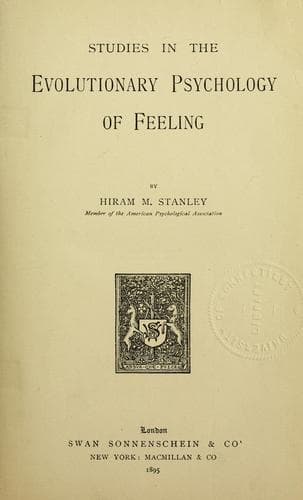
Studies in the Evolutionary Psychology of FeelingStanley, Hiram Miner
Philosophy
Studies in the Evolutionary Psychology of Feeling
Stanley, Hiram Miner
Emotions
and passive touch in active touch, as moved by interest or direct
pleasure-pain. Now pain is not in the mere sight or touch, but is
suggested by them. The whole order—seeing, touching, feeling prick,
feeling pain—is the reverse of evolution order. The rational mode, then,
of interpreting the origin of any sense, whether tactile, visual or
other, is not by receptivity, but through struggle at critical stage
when great pain is actual or imminent. Thus, if the conditions of life
required the development of a special sense of magnetism, it would
surely arise by strongest effort, as, indeed, all progress in special
sensitiveness is now being accomplished. Thus, the anticipatory and
premonitory function of sense does not make it original, rather the
contrary; it is guide and significant of pain-pleasure.
It is obvious that the cognitive tendency once established becomes an
instinct of objectivity and governs the whole mentality. This is
obviously the case with man. He does not exist in that sluggishness and
semi-consciousness where pain-pleasure must arise as primitive impulse,
but by habit and instinct he is passively and actively cognitive. The
eye is continually seeing things spontaneously, the hand touching, but
as to some very small object we have to exert effort to see or touch,
and this was undoubtedly the mode by which all seeing and touching
arose. It is because generations of ancestors actively sensed, that we
automatically sense; the tendency has become ingrained in mind. So it is
that man is predominantly sensing, is continually and naturally awake to
objective conditions, is constantly anticipatory, and so normally senses
before he feels pain-pleasure. However, a man in a “brown study,”
inadvertently touching a hot stove, has pain, then warmth, then touch
sensation, and actively realizes these. So in deep slumber mentality
often begins with pain-pleasure. At bottom the reason we have pain from
a sensing is because we had originally pain-impulse to that sensing, and
the pain therewith. Thus tactility, arising as effortful sensing, was
produced by pain from thing to be touched, to be sensed in its
experimental value. By innumerable painful experiences with hot things,
the hot thing is tactilily appreciated; and as touching is actively
pursued by organism on the alert, the associated pain is more and more
quickly realized from given object. In origin pain was felt from the hot
thing in contact, before either sense of warmth or contact was sensed;
it was this pain that forced to sensing and development of cognition,
which, however, ultimately became habit, and things were constantly
appreciated and anticipated. Thus the touch-warmth-pain order is
established. Sense is significant of pain-pleasure, but the
pain-pleasure came not at first from the sensing, but the contrary;
sensing was determined by it, and became correlated with it, and became
sign of it. The progress is from initial subjectivity to an instinctive
constant objectivity.
Public-domain text, read in full here on John Shaqi.
Reviews
Reviews
No reviews yet
Be the first to share your thoughts on this work.
Join the Discussion
Join the discussion
Sign in to leave a comment or review.
Sign InorCreate an account