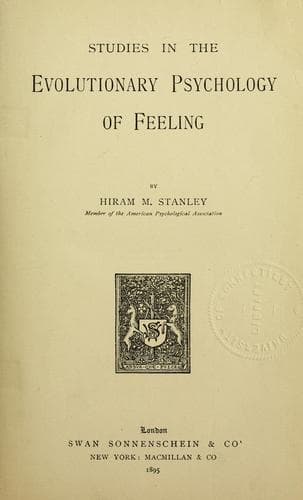
Studies in the Evolutionary Psychology of FeelingStanley, Hiram Miner
Philosophy
Studies in the Evolutionary Psychology of Feeling
Stanley, Hiram Miner
Emotions
Mr. Spencer in discussing this matter remarks that, as “language is the
vehicle of thought, we may say that in all cases the friction and
inertia of the vehicle deduct from its efficiency, and that in
composition the chief thing to be done is, to reduce the friction and
inertia to the smallest amounts.” But it must be remembered that motion
is not only against friction but by friction. The rail may be too smooth
as well as too rough. Every locomotive, for a given piece of track with
a given gradient, has a certain co-efficient of friction for its most
effective working, above and below which there is alike decrease of
efficiency; and in engineering it is equally a problem to keep friction
up as to reduce it. So I say of style, that it may be too smooth and
facile, and may reduce mental friction to so low a point that there is
no grasp and no real progress. A sentence of Hooker or Milton,
magnificent stylists though they are, can, as an affair of economy of
attention, be greatly improved by breaking it up into a number of simple
plain sentences after the primer fashion, The cat mews, The dog barks,
etc.; but this process certainly is not an improvement of their style.
But if economy of attention were the sole secret of style, certainly the
more economy we introduce the greater and better should be the style.
Professor Sherman, of the University of Nebraska, in a recent article
shows that heaviness—that which requires “constant effort in reading”—is
due to the number of words _per_ sentence, which has been reduced in the
course of the history of English prose from an average of fifty words a
sentence in Chaucer and Spenser to five in the columns of a modern,
low-grade, popular story-paper; but it obviously cannot be maintained
that the style of the story-paper is ten times better than that of
Spenser’s _State of Ireland_.
Public-domain text, read in full here on John Shaqi.
Reviews
Reviews
No reviews yet
Be the first to share your thoughts on this work.
Elsewhere in the archive
Join the Discussion
Join the discussion
Sign in to leave a comment or review.
Sign InorCreate an account