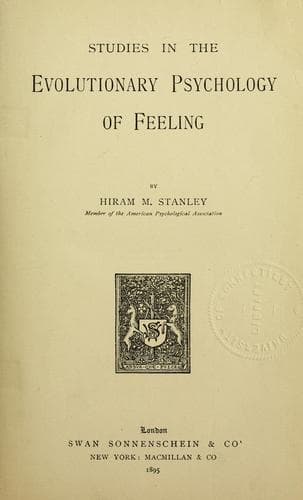
Studies in the Evolutionary Psychology of FeelingStanley, Hiram Miner
Philosophy
Studies in the Evolutionary Psychology of Feeling
Stanley, Hiram Miner
Emotions
We might then set up with plausibility an exactly opposite theory to the
economic, and maintain that the secret of style is in exciting us to the
greatest attentive effort, and that the best style is that which rouses
us to the severest mental exertion. However, I believe that these two
opposite methods of style are complementary. The great stylist is he who
strikes the exact mean between over facility and over difficulty, and
touches the exact co-efficient of mental friction in the reader, at
which his whole power of mind comes into highest and most harmonious and
effective exercise. The accomplished stylist most cleverly throws in
questions, suggests doubts, and defers answers. To read his book is not
a toboggan slide, but an obstacle race. What is plot interest but a
skilful putting of obstacles in the reader’s way, deferring and
thwarting his expectations, putting him on the _qui vive_ of attention?
By the development of plot the novelist and dramatist plays hide and
seek with the reader. No cunning artist reveals at once his whole
thought in a blaze of light, but he mystifies and draws in half-tones,
thus to stir you to reach out and grasp his meaning.
But we are as yet far from exhausting the psychological significance of
pleasure in style when we trace it to a reflex from either decrease or
increase of attentive effort. The pleasure we have so far considered is
naïve and direct; it is from literary art rather than in or at literary
art as such. The child and the most ordinary reader derive from books a
simple and natural pleasure which they do not reflect upon, and do not
in any wise conceive the ways and means by which the effect is produced.
Indeed, in the presence of the most lucid and perfect art these readers,
like Partridge at the play, take everything as a matter of course, as
just the way they would themselves express it. The _dilettante_ alone
tastes the pleasure in style as such; as an art, an adaptation of means
to ends, he alone appreciates the delicate adjustment of expression to
thought, the choice diction, the deft management of word and phrase. The
quality of this technical pleasure in style is exemplified in its
highest form in this note of a great artist-critic, Shelley, appended to
his fine translation of the opening chorus in “Faust”:—
"Such is a literal translation of this astonishing chorus; it is
impossible to represent in another language the melody of the
versification; even the volatile strength and delicacy of the ideas
escape in the crucible of translation, and its reader is surprised to
find a _caput mortuum_."
Public-domain text, read in full here on John Shaqi.
Reviews
Reviews
No reviews yet
Be the first to share your thoughts on this work.
Elsewhere in the archive
Join the Discussion
Join the discussion
Sign in to leave a comment or review.
Sign InorCreate an account