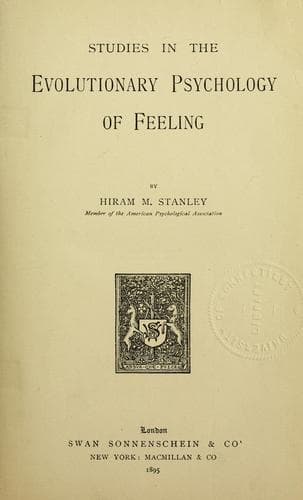
Studies in the Evolutionary Psychology of FeelingStanley, Hiram Miner
Philosophy
Studies in the Evolutionary Psychology of Feeling
Stanley, Hiram Miner
Emotions
The psychological nature of this pleasure in style is obviously quite
distinct from the direct pleasures from reading which have been
previously discussed. Here is pleasure in literary art, not for what it
brings, but for its own sake. The distinction between the pleasure the
average tourist takes in travelling swiftly and smoothly in a _de luxe_
train, and that taken by the professional engineer inspecting the
high-speed locomotive, is analogous in quantity and quality to the
distinctive pleasures of critical and uncritical appreciation of fine
art. But we have as yet only cleared the ground toward ascertaining the
psychological _rationale_ of literary style. We have marked only general
causes of literary pleasure, we have noticed in this pleasure only those
elements which flow from the psychological and physiological basis of
all pleasure as reflex of functioning. That we admire and take pleasure
in nice adjustment of means to ends is also a general law of pleasure
with all who act teleologically, and are capable of appreciating actions
of this kind. But is there not a specific quality in the æsthetic
pleasure from or in literary art which has not yet been accounted for?
Certainly the common expression, “more forcible than elegant,” as
applied to spoken or written language, denotes that for the popular
consciousness style is somewhat more than and different from mere force
and consequent ease and largeness of apprehension. We hear a very loud
sound with greater ease than smaller sounds, there is economy of
attention, yet this does not bestow æsthetic quality on the great sound.
At the renderings of the finest music we are often called on to strain
the ear, and the mental receptiveness as a whole to the utmost, in order
to hear, note, and appreciate the delicate effects. So in literary art
it is not that which speaks most loudly and strongly to the mind that
thereby becomes the best style. In fact, the most forcible method of
expression is often, as is generally acknowledged, slang, which is
debarred from style. Literary style seems, then, more than a mental
labour-saving machine. As a utilitarian device it certainly does save
mental exertion, and gives rapidity, accuracy, and facility to psychic
function. Like grammar, a mechanic rhetoric is useful, and we receive a
pleasure from its use as from any other mechanism of man’s industry; and
further, we may take a certain pride and pleasure in its consciously
recognised effectiveness. However, we have not yet reached style in the
higher sense, which may be clear and forcible, but must be dignified,
graceful, and beautiful. For purposes of business, for conventional
communication, for science, for philosophy, language fulfils its end in
stating accurately, clearly, and forcibly; but style as literary art is
more than instrument to intelligibility, it has an independent office of
its own. Language in the lower service as a medium of communication is a
Public-domain text, read in full here on John Shaqi.
Reviews
Reviews
No reviews yet
Be the first to share your thoughts on this work.
Elsewhere in the archive
Join the Discussion
Join the discussion
Sign in to leave a comment or review.
Sign InorCreate an account