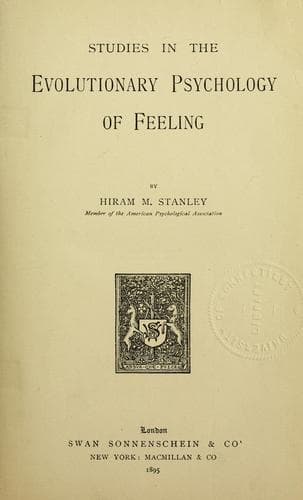
Studies in the Evolutionary Psychology of FeelingStanley, Hiram Miner
Philosophy
Studies in the Evolutionary Psychology of Feeling
Stanley, Hiram Miner
Emotions
However, we have sharply to distinguish between what is given in a
survival state and that which accompanies it. Primitive realization is
always single and naïve, but when it comes up in a survival it is
generally consciously contrasted with accustomed modes by consciousness,
and there arises a reflective pleasure of contrast which is not
contained in the survival itself, but of which the survival is merely a
condition. Further, our realization of the outgrown psychic elements is
very generally dramatic. We take self-conscious pleasure in
investigating, assuming, and re-enacting past psychic phases. Even when
a survival state arises spontaneously and naturally, it holds
consciousness at best in its original _status_ for a moment only, for
self-consciousness quickly occurs and brings in a variety of secondary
emotions. However attained, the obsolescent type of consciousness does
not stand in its simple original force, but most often there is more or
less make-believe, some sense of its artificial and unreal nature: we do
not become children by playing at being children. Children and savages
are in the animistic psychic stage, but the poetic interpretation of
nature by adult man is plainly far more than mere revival of this stage,
it is dramatic self-conscious realization. Original animism is often
painful; the savage fears his gods and the child dreads ghosts; but
myths and ghost stories are sources of amusement to us, and the twinge
of fear which comes up as survival loses its real force and is
dramatically realized and enjoyed. Literary art is a dramatic induction
into the past rather than incentive to mere revival; and it makes us to
pleasurably renew alike the outgrown pains and pleasures. We certainly
should go far astray if we should consider style as effectual mainly by
its exciting to revival of ancestral experiences. What is recurrent is
but a small element compared to what is concurrent.
Public-domain text, read in full here on John Shaqi.
Reviews
Reviews
No reviews yet
Be the first to share your thoughts on this work.
Elsewhere in the archive
Join the Discussion
Join the discussion
Sign in to leave a comment or review.
Sign InorCreate an account