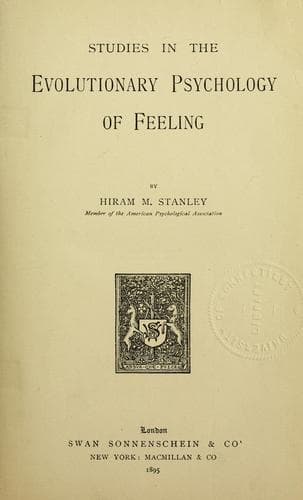
Studies in the Evolutionary Psychology of FeelingStanley, Hiram Miner
Philosophy
Studies in the Evolutionary Psychology of Feeling
Stanley, Hiram Miner
Emotions
We must note the particular case of landscape beauty. Shelley’s
description of the orange tree laden with fruit excites in us the
feeling of pleasure in the beauty of nature, a feeling which is declared
by some to be merely the reminiscent revived feelings which our distant
progenitors felt in the presence of natural forms and forces. But what
was the emotion our remote progenitor felt at sight of a well-fruited
orange tree? Did he feel moved as Shelley was and as we through Shelley
are? and is our emotion but a faint survival of that which welled up in
him at viewing the mass of green and gold, or has it any relation
thereto? The civilized traveller in wild regions is often charmed by the
beauty of the scenery which the savage natives do not in the least
appreciate. But the revival feelings which come over him must be
identical with the feelings of his unæsthetic companions who are totally
insensible to natural beauty. The reversal tendency can give to the
traveller only an animal pleasure in viewing an orange tree as
satisfying to the taste and stomach; a fine, bright day can only suggest
the pleasure of a sluggish basking. Goethe rejoiced that, though the
incidental pains of æsthetic sensitivity were great, yet he could see in
a tree shedding its leaves more than the approach of winter. Bare
revival then cannot in itself constitute æsthetic pleasure or explain
it. A savage race transferred to a civilized land for a few generations
and then returned to their native haunts have acute pleasures of
revival, but these are not of the æsthetic quality. An outcropping
survival tendency may serve as itself an object for emotion and æsthetic
emotion to the mind experiencing it, but thereby the survival is like
any other object, physical or psychical, which excites æsthetic
sensibility, and it no more explains the emotion for beauty than any
other object.
It is evident thus far that the psychological basis of stylistic effect
is very complex, and in this essay we certainly lay no claim to making
an exhaustive enumeration of its factors. However, we have still to
consider one more element, and perhaps, at least for cultivated minds,
the most important psychic element of literary art. Read now the
following extract, and analyze the impression it makes:—
Public-domain text, read in full here on John Shaqi.
Reviews
Reviews
No reviews yet
Be the first to share your thoughts on this work.
Elsewhere in the archive
Join the Discussion
Join the discussion
Sign in to leave a comment or review.
Sign InorCreate an account