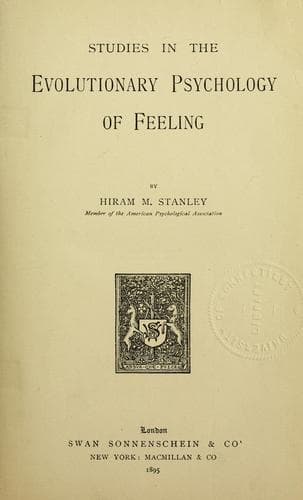
Studies in the Evolutionary Psychology of FeelingStanley, Hiram Miner
Philosophy
Studies in the Evolutionary Psychology of Feeling
Stanley, Hiram Miner
Emotions
The taste and emotion for the characteristic as such, whenever and
however acquired, is certainly a peculiar and definite mode of emotion.
It is far from being the feeling of discipleship, and is often excited
by that which is most remote and opposite to ourselves. We say of a
certain person, “He is a _character_,” and he interests and pleases us
as such, though entirely foreign to us in either sympathy or antipathy.
As an entirely disinterested emotion, the æsthetic is beyond the range
of common naïve consciousness. The enjoyment of the characteristic _per
se_ is specially for the analytically super-conscious cosmopolite and
for the cultured critic. The pleasure comes partly from the novelty and
the contrast reflectively understood, partly from admiration for the
forcefulness of creative personality, its plastic power in forming its
material of expression, and largely a teleologic pleasure in perceiving
fulness and purity of type. The emotion for style as characteristic
expression is plainly one of those which is not due to the utility in
the struggle for existence, but has arisen when experience comes to be
cultivated for its own sake.
When, as in eras like our own, personality weakens, and the inner
plastic and creative force of conviction and emotion decreases, the
writer is driven to technical treatment. The _littérateur_, as he has
little or nothing to say, contents himself with playing tricks on
language, and elaborating rhythms and cadences. Style becomes finicky; a
race of prinking poetasters and priggish prosaists arise, punctiliously
formal, and superlatively dainty, who attain the art of saying nothing
very elegantly, elaborately, and brilliantly. An over-conscious,
over-subtle technique destroys the grand style as transmitter of
characteristic quality.
* * * * *
I trust I have, in this brief study, made it clear that the psychology
of literary style is far from simple, and that a number of factors are
involved, which are slighted by Herbert Spencer and others of that
school. I believe that any one at all conversant with literature who
will reflect upon the pleasures he receives from reading, will perceive
that the pleasure of smoothness and facility, of moving along rapidly
and easily, is but one, and that generally a minor factor in literary
enjoyment. Beside this, he often has the pleasure of difficulties
overcome, of ideas grasped, and delicate emotional touches appreciated
by triumphant attentive effort. Again, he receives pleasure in
perceiving literary skill, the adaptation of artistic means to the
artistic end. But, as I have maintained, the chief mode of pleasure is
through style as transmitter of æsthetic emotion and as expression of
the characteristic, achieving its acme when both these functions are
simultaneously performed most fully and perfectly.
CHAPTER XIX
_ETHICAL EMOTION_
Public-domain text, read in full here on John Shaqi.
Reviews
Reviews
No reviews yet
Be the first to share your thoughts on this work.
Elsewhere in the archive
Join the Discussion
Join the discussion
Sign in to leave a comment or review.
Sign InorCreate an account