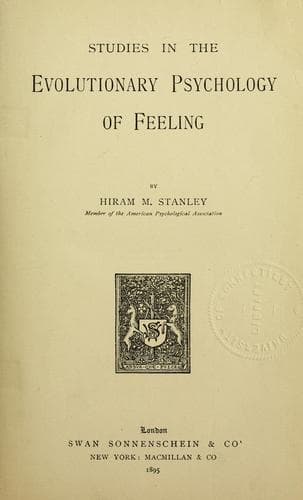
Studies in the Evolutionary Psychology of FeelingStanley, Hiram Miner
Philosophy
Studies in the Evolutionary Psychology of Feeling
Stanley, Hiram Miner
Emotions
The need of a closer psychological definition and interpretation of
ethical emotion must be apparent to any reader of the current
psychology, where we find the utmost confusion and looseness of usage.
One of the most glaring instances which I have come across is this from
Perez (_First Three Years of Childhood_, p. 286): “As soon as the child
begins to obey, from fear or from habit, he enters on the possession of
the moral sense; as soon as he obeys in order to be rewarded or praised
or to give pleasure, he has advanced further in this possession.” A boy
at table reaches out for the last piece of cake, but withdraws his hand
out of love for his mother’s approbation, and fear of her
disapprobation. Does this imply moral sense and emotion? We say, indeed,
that these were very proper and moral emotions for the child to have;
objectively moral, but we do not describe the psychical state of the
child correctly by saying that it has the moral sense and emotion. In
fact, just so far as he acts out of love or fear, just so far he is not
acting out of ethical emotion; that is, simply because he feels he
ought.
Only the slightest introspection, then, is needed to recognise the
distinction of objective and subjective morality, of a moral emotion and
the emotion of morality. So we must disallow even dread of “moral
discomfort” as psychically moral, Spencer notwithstanding (_Essays_ I.,
p. 348). The fear of remorse may restrain from objectively immoral acts,
but the ethical emotion is not a fear constraint, as every one knows
when doing a thing simply because he feels he ought to. Because I judge
my feeling or act a right one, does not constitute this the feeling of
rightness as psychic fact. In short, we must always distinguish between
the socially right action, the morally right action, and the
psychologically moral action. He who erects a model tenement, even
though he do it to advertise himself, is doing the right thing by
society, though his action is neither prompted by a moral emotion nor
the moral emotion. If philanthropy incites him, both the act and feeling
objectively are moral, but psychically he is immoral, and only becomes
psychically moral when he acts out of the ethical emotion as feeling of
duty. One who acts out of sympathy, pity, mercy, affection, feeling of
honour, love of approbation, and similar emotions, often confounded with
the moral emotion, is objectively moral. We pronounce these to be right
emotions, yet they are not the emotion of right, and so not psychically
moral; and it is evident, also, that they may not be socially right, for
often actions from these motives result in social wrongs. However, in
later phases of psychic evolution, when emotions themselves are
reflected upon as psychic acts, the emotion of the moral “ought” may be
felt as stimulus to them, and so we may at once feel that we ought to
sympathise, and so sympathise, and so act, and may thus at the same time
be psychically, morally and socially right.
Public-domain text, read in full here on John Shaqi.
Reviews
Reviews
No reviews yet
Be the first to share your thoughts on this work.
Elsewhere in the archive
Join the Discussion
Join the discussion
Sign in to leave a comment or review.
Sign InorCreate an account