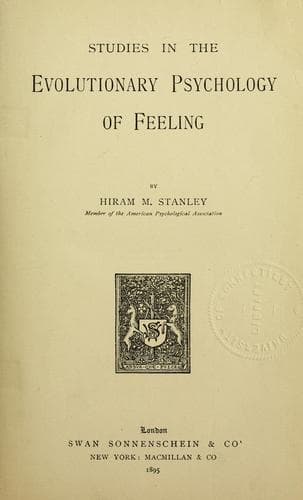
Studies in the Evolutionary Psychology of FeelingStanley, Hiram Miner
Philosophy
Studies in the Evolutionary Psychology of Feeling
Stanley, Hiram Miner
Emotions
The psychic conflict which is specially connected with moral emotion is
the conflict of the egoistic and altruistic impulses. When in such a
struggle sympathy prevails, we approve as objectively moral and right,
but the existence of ethical emotion in determining the dominance of the
altruism is not assured. Pity originally overcame hatred without the
compulsion of duty. Altruistic impulses contest with egoistic in naïve
and simple natures without any appearance of feeling for duty. The
origin and nature of morality does not thus seem bound up with the
earliest forms of egoistic-altruistic contests, though in later
evolution it may come in as reinforcement of the altruistic. We may feel
then, not merely like helping a man in distress at the expense of our
own comfort, but we feel we ought to help him; the force of a general
principle of conduct is felt in the form we term the ethical emotion,
yet it is obvious that such a recognition of a general and universal law
and such a feeling therefor is far later than the rise of altruism
itself. Darwin alludes to the baulking of the social instinct as having
special ethical significance. With the social instinct baulked, as with
any other, there certainly results distress, but it is by no means made
clear that this necessarily involves moral quality. When a savage in a
fit of anger slays his pet child, the misery of baulked parental
instinct may soon be felt, and he may bitterly regret the deed, but this
does not involve moral feeling, a feeling of repentance for the
essential wrongfulness of the act. He would regret in the same spirit
the destroying his dinner by his own hand. If we say that he is stricken
with remorse, we assert conscience violated. Remorse cannot explain
conscience, but must be explained by it. Still, morality is not bound up
necessarily with sociality. Sociality certainly arises and progresses to
a considerable evolution before moral compulsion and the emotion of bare
rightness arises to sanction and to stimulate social activities. And if
moral emotion is not implied positively in altruism as an outgoing
towards others, neither is it implied in the incoming of others upon the
individual, either in respect of approbation or disapprobation, or in
the more direct and essential way of rewards and penalties. Penalty is
at bottom but a species of disadvantage brought to bear on the
individual through fear of consequences. The desire to get even—an eye
for an eye and a tooth for a tooth—and all exacting justice as an
equivalence, whether as exacted by the individual or by persons
delegated, the officers of justice, is plainly not in its origin and
basis the ethical emotion. A system of mutual dues and rights may or may
not have the sanction of morality, but they arise in advantage; and the
motives which originate penalties and act with reference thereto, are
far from being the pure moral emotion, a direct feeling for rightness as
rightness.
Public-domain text, read in full here on John Shaqi.
Reviews
Reviews
No reviews yet
Be the first to share your thoughts on this work.
Elsewhere in the archive
Join the Discussion
Join the discussion
Sign in to leave a comment or review.
Sign InorCreate an account