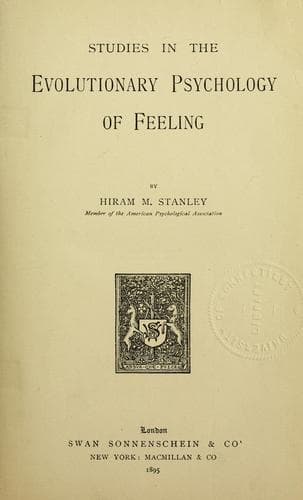
Studies in the Evolutionary Psychology of FeelingStanley, Hiram Miner
Philosophy
Studies in the Evolutionary Psychology of Feeling
Stanley, Hiram Miner
Emotions
It is true, however, that the feeling for the larger and future good
against a present inclination may be a feeling of oughtness, a feeling
of duty, a constraining to do a set something. Providence and prudential
action are enforced not merely by, “I wish to get the larger good,” but,
“I ought to reach it.” The most permanent, the greatest and completest
pleasure and benefit not only incites us, but constrains us.
Constraining emotion, a feeling of oughtness, may then arise both from a
preview of bare accomplishment of plan or purpose set by ourselves or
others, and also from sense of larger over lesser advantage. Here is the
region of utilitarian duty, of the Ethics of calculation of personal
pleasure and happiness. Psychically here is a true feeling of ought, and
here is the ethical emotion, if we make the term denominate all feeling
of oughtness. But if this is the region of Ethics, it may be said to be
the region of the lower Ethics, and we may indeed deny the term ethical
to all this kind of emotion of oughtness. The emotion arises about
personal and particular ends, and not about principles. The ambitious
man feels an ought as well as the conscientious, but they are diverse in
nature. Alike merely in the general quality of compulsive force, they
may differ in tone and special qualities. The constraining emotion which
comes with viewing a universal law of right may be claimed as distinct
from the constraint exercised by personal ends. But it is not our
purpose to discuss this matter here.
Public-domain text, read in full here on John Shaqi.
Reviews
Reviews
No reviews yet
Be the first to share your thoughts on this work.
Elsewhere in the archive
Join the Discussion
Join the discussion
Sign in to leave a comment or review.
Sign InorCreate an account