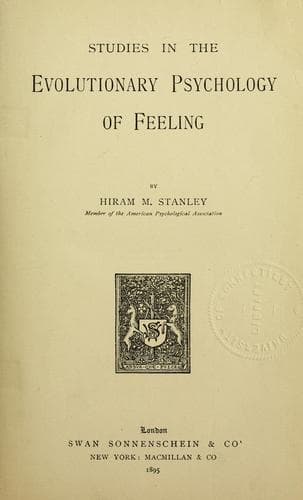
Studies in the Evolutionary Psychology of FeelingStanley, Hiram Miner
Philosophy
Studies in the Evolutionary Psychology of Feeling
Stanley, Hiram Miner
Emotions
But it will be said, “Is not ethical discrimination a cognitive
activity? Must not one know the right, know that he ought, before he can
feel ethically and act ethically?” But it will be found that at bottom
the rightness of an action is the appreciated accord of the action with
an end which is already felt to be right. I am asked whether I think it
was right for a certain poor man to purloin a loaf from a baker for his
starving family. In passing ethical judgment I simply fall back on some
ethical postulate. The right of the family to life, I may say, ought to
take precedence of the right of property. I therein fall back upon the
simple feeling of right as ethical emotion. The knowing activity is
concerned merely in the apprehending the situation, and ratiocination in
tracing back to moral principles, but the ethical discrimination is
neither, but an affair of direct emotion. If it be felt to be right to
save life in any wise that seems necessary, I will approve it as right.
A reason can only make an act right by being a right reason. Thus it is
that moral discrimination is at bottom no more than a peculiar feeling
about acts, towards or against the doing them, which, like all emotion,
involves the knowing its object, but is not involved or explained in its
psychic quality by the knowing act. The setting out what ought to be
done, the establishing duties and moral rules of conduct, the
development of a system of Ethics, is not then fundamentally cognitive
process, but emotive. Hence it is, psychically speaking, a misnomer to
denote any system of Ethics a science.
It is true we may denote by Ethics—always capitalizing the term—that
branch of psychology and sociology which investigates the nature and
laws of ethical phenomena. This Ethics merely gives an objective account
of ethical emotion and conduct. It is often defined as the science of
conduct, a definition quite too wide, for conduct is action consciously
self-directed to an end, be the impulse anger, fear, love, ethical
emotion, or any other emotion; but psychological Ethics studies only
conduct as moved by ethical emotion. Conduct is, indeed, the sphere for
ethical feeling, and any specimen of conduct, whatever its psychic
stimulus, may excite moral approval or disapproval and stir ethical
emotion, but this ethical survey of conduct is not properly a science,
as has just been shown. All conduct is then objectively interpretable as
moral, though it be inherently and psychologically immoral, that is,
having no element of moral feeling. The spheres of objective and
subjective morality are far from being coincident.
Public-domain text, read in full here on John Shaqi.
Reviews
Reviews
No reviews yet
Be the first to share your thoughts on this work.
Elsewhere in the archive
Join the Discussion
Join the discussion
Sign in to leave a comment or review.
Sign InorCreate an account