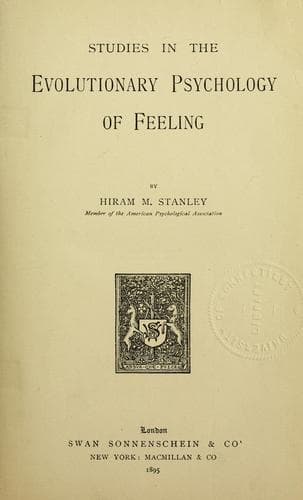
Studies in the Evolutionary Psychology of FeelingStanley, Hiram Miner
Philosophy
Studies in the Evolutionary Psychology of Feeling
Stanley, Hiram Miner
Emotions
Further, science is not peculiarly related above common knowledge to
ethical emotion. Common sense and ordinary fear lead me to jump off the
track before an approaching train, while physiological knowledge and
ordinary fear may incite me to put on rubbers on a wet day. Scientific
knowledge opens the way for the common emotions; it shows the
consequences of acts with fulness and accuracy, and so opens a wide
range for the ordinary emotions which awake at sight of the experienced
and experienceable. If I feel I ought to put on rubbers, this feeling
arises, not directly at the consequences which science reveals, but at
the rightness of the consequences. I feel I ought not to injure my
health, a feeling which science does not generate, but it merely
establishes the fact that such and such actions will injure my health,
and so gives the opportunity of applying the moral postulate, I ought
not to injure my health. I judge the rightness of an act, not by its
consequences, but by the rightness of its consequences.
Again, science reveals most clearly the necessary means to ends; it says
that to make nitro-glycerine you must use such and such ingredients. In
viewing these means in their necessity there may arise a certain emotion
of compulsion to their use; but this compulsive quality is not, I ought
to do so and so, but I must, if I would attain the end. It is plainly an
unethical use of terms to say, If you wish to succeed or be happy you
ought to do so and so, or that is the right way to succeed or be happy.
Morality is not a recipe toward any end but itself. So the feeling as to
the “Conditions by fulfilment of which happiness is achieved”—emphasized
by Spencer in the principles of Ethics as the main element in moral
emotion—is not real ethical emotion. I may feel the constraint and
necessity to using certain means, difficult and unpleasant in
themselves, in order to reach a desired end, but a moment’s
introspection shows that this compulsive emotion is not thereby moral,
that this feeling is not a feeling of duty but of necessity to employ
the means. If I feel that I ought to become happy, then alone will I
feel I ought to use the means to happiness. So also a man may desire to
win in athletic competition, but the requisite means, a hard course of
training, may deter him from entering; that is, his love of ease
conflicts and overcomes his desire of athletic success as far as action
is concerned. If he undertakes the training and struggles through, he
feels the compulsion of the means in direct proportion to his love of
ease and pleasure. He refuses a cigar under this emotion at the
necessity of the means, but this is plainly not a case of ethical
emotion; he refuses, not because he ought, but because he must, and the
trainer who says to him, “You ought not to take that cigar,” does not
primarily appeal to moral principle, but to the constraint of the means
to desired end. This does not deny that a man may feel training as a
Public-domain text, read in full here on John Shaqi.
Reviews
Reviews
No reviews yet
Be the first to share your thoughts on this work.
Elsewhere in the archive
Join the Discussion
Join the discussion
Sign in to leave a comment or review.
Sign InorCreate an account