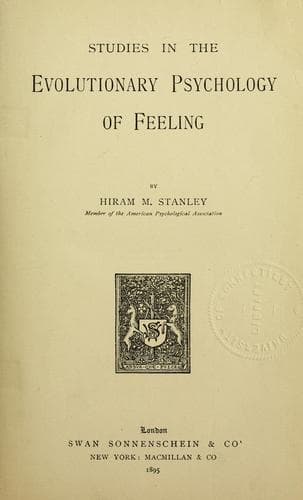
Studies in the Evolutionary Psychology of FeelingStanley, Hiram Miner
Philosophy
Studies in the Evolutionary Psychology of Feeling
Stanley, Hiram Miner
Emotions
matter of duty, but it is still obvious that he who refuses a cigar as a
mere matter of training, is as psychic fact actuated by an emotion of
distinct quality from that which the man feels who refuses to smoke as a
matter of conscience; the feeling, “I must not,” is diverse from the
feeling implied in, “I ought not.” The athlete may be conscientiously an
athlete, but in general he refuses to smoke merely because that is the
right stand, _i.e._, suitable to gaining the particular desired end,
whereas the conscientious man refuses as determined by a feeling for
some end whose rightness is assumed, as the preservation of health, or
the being inoffensive to others. The athlete is moved by what is right
or useful to some end, while the psychically moral man is actuated by
the emotion for the end of rightness; and while constraint appears as
characteristic of both emotions, still in breadth, depth, and particular
tone, the ethical is plainly differentiated from the necessitarian
emotion. At bottom also it is plain that the feeling of compulsion to
means is a case of conflict of motives—as with the athlete is love of
pleasure of smoking _versus_ desire of athletic success—and conflict of
motives has been previously discussed.
Neither scientific nor common knowledge then can as method of means give
by itself the moral emotion. But it may be said that science does
provide ends for action and that the emotion about the end is an ethical
emotion. Thus the end of truth, of adherence to reality, is naturally
emphasized by science; yet here is not duty, but the essential guiding
emotion is the emotion for achievement and the achievement of the
desired accordance with nicety and completeness. The enthusiasm for
truth and truth in action is an emotion which may be sanctioned by moral
feeling, but it is not moral feeling. Adaptation to environment or
conformity to reality as a general end of action may have its impetus in
moral emotion, I may feel that I ought to accord with the nature of
things as scientifically revealed, but this motive is by no means
necessarily implied in the end. And conduct is rarely actuated by pure
sentiment for this end; rather the general form is, “Do this and thou
shalt live”; that is, the emotion is desire for personal ends to which
accordance with nature is the means.
Public-domain text, read in full here on John Shaqi.
Reviews
Reviews
No reviews yet
Be the first to share your thoughts on this work.
Elsewhere in the archive
Join the Discussion
Join the discussion
Sign in to leave a comment or review.
Sign InorCreate an account