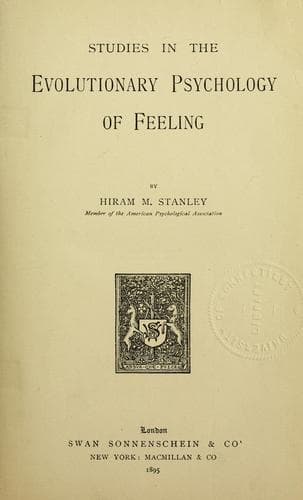
Studies in the Evolutionary Psychology of FeelingStanley, Hiram Miner
Philosophy
Studies in the Evolutionary Psychology of Feeling
Stanley, Hiram Miner
Emotions
There are two points further with reference to expression which merit a
few remarks. The first is as to the reaction of expression on emotion.
We have treated to some extent the relation of emotion to its
expression, but we have also to consider the relation of an expression
to its emotion and to emotion in general. We have all along assumed that
the emotion as a factor in the evolution of life is an internal stimulus
to a serviceable activity, which may be viewed as its expression, or may
even have its value as such. That emotion, as stimulus of action,
determines expression is, I think, a primary law. However, Prof. James
maintains (_Mind_, xxxiv., 188) the reverse—that expression determines
the emotion.[H] We do not strike because we are angry, but we are angry
because we strike. Hence, in reality, the emotion is really the
expression, that is, the emotion is the consciousness result of the
so-called expression—it expresses the “expression” in terms of
consciousness. We commonly speak of expressing our emotions, but we
should rather speak of emotions as expressions in consciousness of
certain bodily activities. But if we make emotion but a psychological
incident and off-shoot of certain activities, I take it we run directly
counter to the general function of mind in evolution as internal
stimulant to useful activity. Emotion is, I judge, fundamentally a
motive force and has its function, and so its rise and development as
such. It is more than a by-product, but even if it were, how should we
account for it? After the serviceable activity has actually been brought
about, after a man has really struck down his adversary, what is the
utility of emotion? We take it that the value of emotion lies in
starting and supporting the activity, and it is advantageous economy
that it cease immediately on the accomplishment of its end. While we
must always suppose that emotion has its physical support in central
neutral changes, yet the expression is truly such; that is, it is from a
different impulse as determined by the emotional brain excitement. In
the light merely of a theory of natural selection, mind in general, and
emotion in particular, is more than incidental concomitant of physical
changes, more than echo of corporeality: it has a vital and central
function in the evolution of life. Prof. James points to the fact that
exercising the expressions or imagining the feeling calls up the
feeling, as a proof of his theory. This, however, is merely a matter of
association, and can prove neither a real precedent nor resultant. We
may call up ideation as well as emotion by producing associated
activities. In the interdependence of the conscious life, emotion,
perception and willing call up each other without reference to causative
order. Any one element of consciousness may be regarded either as
resultant or stimulant, according as we look at preceding or following
state of consciousness. In the order of evolution, pain and pleasure
Public-domain text, read in full here on John Shaqi.
Reviews
Reviews
No reviews yet
Be the first to share your thoughts on this work.
Elsewhere in the archive
Join the Discussion
Join the discussion
Sign in to leave a comment or review.
Sign InorCreate an account