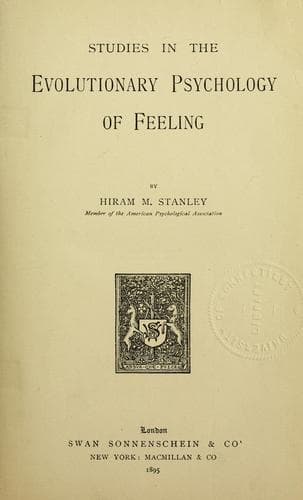
Studies in the Evolutionary Psychology of FeelingStanley, Hiram Miner
Philosophy
Studies in the Evolutionary Psychology of Feeling
Stanley, Hiram Miner
Emotions
arise from certain actions in order to inhibit or stimulate repetition
of actions. Feeling is then, both resultant and stimulant. The emotions
may arise from the expressions by association, but the original
dependence is that of expression on emotion. The further test, that we
cannot imagine an emotion without bringing in bodily presentation, is
simply a necessity of the imaging faculty as such, an image by its very
nature being concrete.
-----
Footnote H:
Professor James has of late largely modified his view (see
_Psychological Review_, Sept., 1894).
-----
While, then, I believe that emotion is the spring of expression, I am
far from denying that the expression may not react upon the emotion.
Whenever the will in any wise controls expression we mark modifications
in the feeling. In the later evolution of life the directing of
expression is of great importance, and expression is gradually subjected
to the will. Hence, especially with man, it becomes possible to feel in
certain ways and yet to repress the signs of feeling, to have strong
emotions, and yet not betray them to those who might take advantage of
them. When a strong emotion is forcibly and completely checked in its
expression there is commonly rankling. At least it is not true, as
Darwin states (_Ibid._, p. 360), that “repression, as far as this is
possible, of all outward signs softens our emotions.” Very often, as we
all know by personal experience and by observation, the checking the
free expression of emotion tends to intensify, rather than soften, the
emotion. The school-girl, who, on hearing sad news, rushes away to have
a good cry, weeps away her grief, and experiences a deep sense of
relief; while the man who sternly represses the expression of grief
often suffers acutely and long. Grief, of course, sometimes lies too
deep for tears, and we often long to be able to express the pent-up
emotion which chokes us. This state is the opposite of the free, natural
expression of feeling such as we see in children. Children express
themselves without self-control, for this is beyond them; but here is
the power to will expression, but the effort is always futile.
Public-domain text, read in full here on John Shaqi.
Reviews
Reviews
No reviews yet
Be the first to share your thoughts on this work.
Elsewhere in the archive
Join the Discussion
Join the discussion
Sign in to leave a comment or review.
Sign InorCreate an account