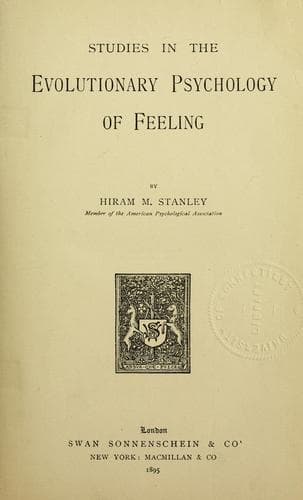
Studies in the Evolutionary Psychology of Feeling — John Shaqi
Studies in the Evolutionary Psychology of FeelingStanley, Hiram Miner
Philosophy
Studies in the Evolutionary Psychology of Feeling
Stanley, Hiram Miner
Emotions
That consciousness is not always conscious of its own intensity is then
shown by direct introspection. And in general we must observe that every
psychosis has its own intensity, which intensity may or may not be noted
by a consciousness of intensity. If there come a consciousness of
intensity, this consciousness has its own intensity, which may be noted
by a new consciousness, whose intensity may in like manner be noted by a
new consciousness, etc., _ad infinitum_. That is, a consciousness is
never its own intensity, and intensity is never a consciousness, such as
pain or pleasure, but is mere comparative objective quality.
Again, consciousness has almost from the first different degrees of
activity, but it would be most unlikely that so complex an act as
consciousness conscious of its own intensity should be primitive and
early. Also, if consciousness develops as life factor it must be
immediate utility which determines its early forms. Hence on this
general principle of biologic evolution it is most unlikely that
primitive organisms will both have consciousnesses and consciousness of
their intensity, for of what direct and vital value is this
intensity-consciousness as psychic mode? On the other hand it is
obviously desirable that psychoses should early differentiate intensity
as objective quality, _i.e._, without self-awareness of it, should have
different degrees of a psychosis to meet different degrees of
requirement; thus to fear strongly or weakly according to necessity of
the case. To have fear set at one pitch for all cases is perhaps
absolutely primitive, but differentiation is early. But to fear more or
less, _i.e._, at different intensities, is not to have intensity as
subjective element, an actual psychosis constituent appreciated as such,
which is very late evolution since the demand for it is late. In thus
defining the category of intensity we have plainly isolated it from the
pleasure-pain category. We know pleasure or pain as act of consciousness
just as we know volition or sensation. Pain and pleasure are definite
facts like seeing or touching or willing, and are so recognised by
common consciousness. One or the other may be involved in all
experience, but this does not make them general qualities like
intensity. Pain is a consciousness, intensity is not a consciousness.
This is the immediate value of the terms, the very names convey
distinctness of category. I have a pain, I do not have an intensity; I
am in pain, I am not in intensity. My pain is intense, but I cannot say
my intensity is painful. We experience pain and pleasure, but we never
experience intensity.
Public-domain text, read in full here on John Shaqi.
Reviews
Reviews
No reviews yet
Be the first to share your thoughts on this work.
Join the Discussion
Join the discussion
Sign in to leave a comment or review.
Sign InorCreate an account