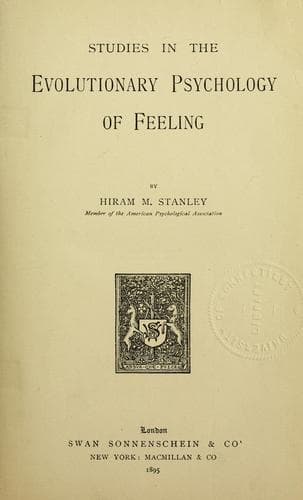
Studies in the Evolutionary Psychology of FeelingStanley, Hiram Miner
Philosophy
Studies in the Evolutionary Psychology of Feeling
Stanley, Hiram Miner
Emotions
Any theory of pleasure-pain then from the point of view of pure
psychology, as explaining it by reference to other modes of
consciousness, is, we think, unsatisfactory. But perhaps the
physiological point of view will be more satisfactory. It is generally
considered that the function and origin of pain is in what is
unfavourable to physiological function, of pleasure, in what is
favourable. I cut my finger, and the pain says, stop the injurious
action. However, there are exceptions. I taste sugar of lead; it is
pleasant, and I keep on tasting, and am poisoned. Lotze explains that
this sweetness is immediately soothing and advantageous. “We must not
regard pleasure,” says Grant Allen, as “prophetic.” But what has been
the evolution of taste as sensing act except to be “prophetic,” to give
at the opening of the alimentary canal a monitor to the stomach and
other digestive organs? That it tastes sweet, that this taste is
pleasant, and so the substance is swallowed, or that it tastes bitter
and unpleasant, and the substance is rejected; this surely is
anticipatory and “prophetic.” The taste for sweetness is not evolved for
itself; but for its life value; and hence Lotze’s explanation fails from
the point of view of evolutionary psychology. The organic sweet is the
nutritious and beneficial, and the sensing this quality in connection
with these favourable and pleasant effects on the stomach and organism
as a whole has led to a taste and liking for sweetness. “Sweet and
wholesome” is the common and just conception. But if mineral sweets
injurious to life, like sugar of lead, had been a common environment,
and the only sweet known, this sweetness would have been as unpleasant
as the sour or acid now is. We see even now that sweets that have
several times caused nausea, though at first highly agreeable, come to
be distasteful and disgustful. We now find that sour and bitter
substances are disliked by animals in general as painful, for the sour
and bitter is general sign of the unwholesome; but those animals which
live almost exclusively on bitter herbs undoubtedly appreciate this
quality as we do a _bon bon_. Men lost in a desert by pertinaciously
tasting bitter herbs and becoming dependent upon them for support would
soon realize their bitterness as pleasant, and a race might originate to
whom sweetness would be unpleasant. Hence the value of a sensation does
not—in natural evolution—lie in itself, it is merely a guide and index;
and the sensation quality will be pleasant or unpleasant according to
its relation to the demands of life. A sensation is inherently either
pleasurable or painful, but not essentially one and not the other, hence
the proverb, _de gustibus non disputandum_. The sensing act in itself is
indifferent, _i.e._, sweetness and bitterness, purely as tastes, as
sensing acts, are indifferent; but as matter of fact having grown up
with and for pleasure-pain tones as indicative of life values, they are
Public-domain text, read in full here on John Shaqi.
Reviews
Reviews
No reviews yet
Be the first to share your thoughts on this work.
Join the Discussion
Join the discussion
Sign in to leave a comment or review.
Sign InorCreate an account