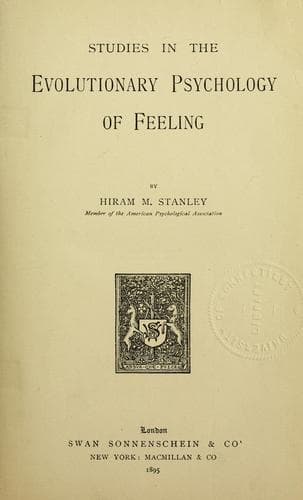
Studies in the Evolutionary Psychology of Feeling — John Shaqi
Studies in the Evolutionary Psychology of FeelingStanley, Hiram Miner
Philosophy
Studies in the Evolutionary Psychology of Feeling
Stanley, Hiram Miner
Emotions
But the grievous lack of generally accepted results is most apparent in
the domain of feeling. The discussion of feeling in most manuals is very
meagre and unsatisfactory. Professor James’s recent treatise, for
instance, gives some 900 pages to the Intellect, and about 100 pages
each to Feeling and Will. There is little thorough analysis and no
perfected inductive classification. We often, indeed, find essays of
literary value which appeal to the authority of literature. But to refer
to Shakspeare or Goethe as psychological authorities, or in illustration
or proof of psychological laws, is generally a doubtful procedure. The
literary and artistic treatment of human nature is quite distinct from
the scientific, and literature and art cannot be said to be of much more
value for psychology than for physics, chemistry, or biology. To appeal
to the Bible or Shakspeare in matters psychological, is usually as
misleading as to consult them for light on geology or botany. Even the
fuller treatises on the subject of feeling rarely reach beyond literary
method and common observation, being for the most part a collection and
arrangement of the results of common sense, accepting common
definitions, terms, and classifications. Now, science is always more
than common sense and common perception, it is uncommon sense; it is an
insight and a prolonged special investigation which penetrates beneath
the surface of things and shows them in those inner and deeper relations
which are entirely hid from general observation. Common views in
psychology are likely to be as untrustworthy as in physics or astronomy,
or any other department. Science must, indeed, start with common sense,
but it does not deserve the name of science till it gets beyond it.
Again, the subject of pleasure, pain, and emotion, is usually discussed
with considerable ethical or philosophical bias. The whole subject of
feeling has been so naturally associated with ethics and philosophy from
the earliest period of Greek thought that a purely colourless scientific
treatment is quite difficult. Furthermore, feeling has been too often
discussed from an _a priori_ point of view, as in the rigid following
out of the Herbartian theory of feeling as connected with hindrance or
furtherance of representation. Still further, the physical side of
emotion has been so emphasized by the physiological school as to
distract attention from purely psychological investigation.
Public-domain text, read in full here on John Shaqi.
Reviews
Reviews
No reviews yet
Be the first to share your thoughts on this work.
Join the Discussion
Join the discussion
Sign in to leave a comment or review.
Sign InorCreate an account