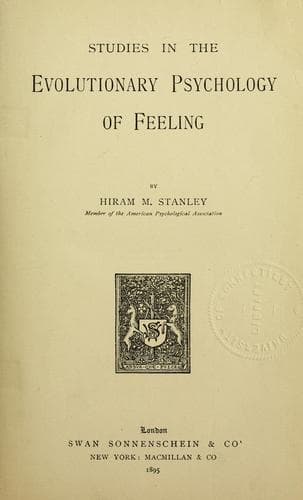
Studies in the Evolutionary Psychology of FeelingStanley, Hiram Miner
Philosophy
Studies in the Evolutionary Psychology of Feeling
Stanley, Hiram Miner
Emotions
Sensations are, then, by no means such original and simple elements of
mind as often conceived; but they are developed forms of some general
undifferentiated cognitive state, sensation as bare apprehension of
bodily disturbance, and this itself cannot be accounted absolutely
original. The evolution into particular modes of sensation, as sense of
heat, hunger, light, pressure, etc., is in the struggle for existence
gradually achieved, and also therewith the evolution of special
sense-organs. And we must always bear in mind that it is not the
sense-organ that develops the sensation, but on the contrary the effort
at sensing that produces, maintains, and improves the sense-organ. The
eagle’s eye has been developed by unceasing straining as incited by the
necessities of existence felt in pain and pleasure. It is natural for us
at our stage of development to suppose that the organs of sense _give_
sensations and to explain the sensation by the physiological organ; but
when we reflect that sensations _come_ to us from the organ only up to
the measure of the momentum from heredity, we see the insufficiency of
purely physiological interpretation. Evolution to-day is on the same
basis as evolution at any period, and as it always has been, it always
will be, dependent upon a ceaseless _nisus_. It is only by painstaking
effort—labour—that man progresses in sensibility, and this effort has
always an incentive in some form of interest that is pleasure-pain
basis. Thus it is that the astronomer’s eye, the microscopist’s eye, the
artist’s eye, is formed. The multiform sensibility of the tea-taster is
attained by assiduous tasting, and the development in organ only follows
_pari passu_. What is seemingly simple and original in sensation for us
was, no doubt, like the very special forms of sensibility acquired by
our specialist, achieved by the lower forms painfully and toilfully, and
passed on to us. Our highest feats of sensation and insight may likewise
for our remote descendants be intuitions, whose apparently simple nature
may be asserted as the basis of philosophic systems. A genius is one who
antedates the general stage of progress of his period by having as
intuitions, as seemingly direct and simple knowledges and sensations,
what is beyond or barely within the intensest effort of his
contemporaries, though it may become common and easy for all men of
later ages.
Public-domain text, read in full here on John Shaqi.
Reviews
Reviews
No reviews yet
Be the first to share your thoughts on this work.
Elsewhere in the archive
Join the Discussion
Join the discussion
Sign in to leave a comment or review.
Sign InorCreate an account