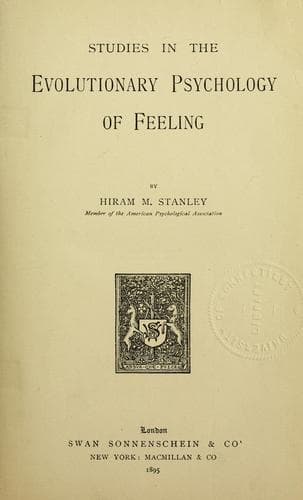
Studies in the Evolutionary Psychology of FeelingStanley, Hiram Miner
Philosophy
Studies in the Evolutionary Psychology of Feeling
Stanley, Hiram Miner
Emotions
We have also to emphasize this, that while representation involves a
conscious re-objectifying, it must also include some re-feeling
consciously accomplished of pain and pleasure. Revivals of pain and
pleasure are felt and are appreciated as revivals, as having their basis
not in present object, but in previous experience. It is by
understanding feeling as experienced and experienceable, it is in view
of pleasure-pain experience, that emotion arises. It is not sense of
imminence of object, but of imminence of pain and pleasure, that awakens
responsive emotion and so self-conservative action. Emotion always
implies a pleasure or a pain in ideal sense of the experienceability of
either. Representation as cognitive revival and sense thereof is
subsidiary to representation as feeling revival with sense thereof. For
instance, the representation of a tooth and of pain of toothache are
correlative representations. Mere representation of cognition has no
value in itself, is a mere idle panorama, save as it brings on
representation of pleasure-pain. Unless representation of object implies
representation of pain, there is no deterrent effect on the mind, and no
proper bodily reaction.
We may believe that the order and basis of the representative side of
mind is practically the same as indirect and simple activity, that the
actual motive forces and originating impulses are pleasures and pains.
We should suspect that the first revival attained was a pure feeling
revival, and that the first representation was of pain and pleasure, and
not of object, a consciously re-feeling rather than a consciously
re-objectifying. The immediate value of the feeling side necessitates
that all differentiation be initiated there.
Representation is only of experience of things or of pleasure-pain
experience. It is always experience of experience, hence the expression,
representation of an object, is, in strictness, inaccurate. Experience
of things, as cognitive act, is always presentation. Yet early
representation must be considered as very much adulterated by
presentative elements. It was only slowly that representation was
differentiated as a distinct power such as we find it in human
consciousness; at the first it must have resembled the confused state
that we sometimes experience between sleeping and waking when a given
image often shifts from presentation value to representation value, and
then back again.
Representation at the first is also purely concrete and particular. Bare
appreciation of the experienceable does not include idea of experience.
But representation in itself is merely a calling up and application of
definite experiences as such. Experience as general term is not known,
but only the particular facts as experiences.
Public-domain text, read in full here on John Shaqi.
Reviews
Reviews
No reviews yet
Be the first to share your thoughts on this work.
Elsewhere in the archive
Join the Discussion
Join the discussion
Sign in to leave a comment or review.
Sign InorCreate an account