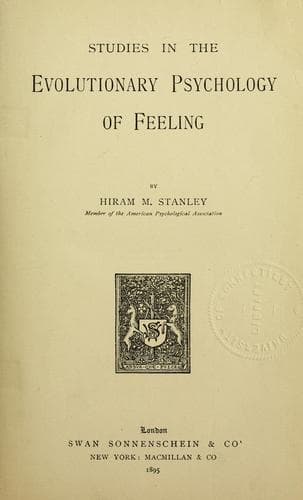
Studies in the Evolutionary Psychology of FeelingStanley, Hiram Miner
Philosophy
Studies in the Evolutionary Psychology of Feeling
Stanley, Hiram Miner
Emotions
The earliest emotions arise, of course, with reference to the bodily
functions which have the most direct vital significance, as nutritive,
reproductive, and motor activity. Very simple organisms seem to
apprehend that a certain object is food before actually consuming, to
have sense of the experience, and some emotive disturbance. The pleasure
of feeding and incorporating into the bodily tissue is sensational, but
any feeling previous or subsequent to this and with reference to this is
emotional. A very young child feeds, and does not know food. Gradually
it associates the visual sensation of whiteness of the milk with the
immediate taste sensation and pleasure feeling. But the sense of
whiteness at first arises only with and after the actual taste and
pleasure experiences; it only gradually notices what gives it
satisfaction or pain, thus repeating the evolution of mind, which is
from feeling to sense, and not _vice versâ_. Only slowly does it attain
power of appreciating whiteness previous to actual experience and as
_indicative of such_, that is, a power of representation. Then emotions,
as expectancy, and desire, become possible, and will can be stirred to
active appropriation of food, a fact of the greatest importance in the
struggle for existence. Once attaining the sense of the representative
value of its cognitions, the child is enabled to consciously accomplish
anticipatory actions.
An element which complicates emotion at a late stage is representation
of representation in indefinite _regressus_. In advanced human
consciousness, where mind is very reflective and introspective, this
phase is prominent. The _nuances_ of modern emotion are largely due to
this mode of complication. Montaigne remarks that what he most fears is
fear. As fear implies representation, fear of fear implies
representation of representation, which in its turn may be feared, and
so on _ad infinitum_. Spencer terms love of property a re-representative
feeling; but this psychosis does not imply representation of
representation, but merely representation of desirable realities. Desire
of possession is an emotion, but not emotion at emotion. It is not an
experience in view of representative experience, but with reference to a
direct experience, that of ownership. Since we make representation the
basis of emotion, it would be natural to make classes of emotion
representative, re-representative, etc.; but this is quite too subtle a
distinction to be fruitful or practical.
Public-domain text, read in full here on John Shaqi.
Reviews
Reviews
No reviews yet
Be the first to share your thoughts on this work.
Elsewhere in the archive
Join the Discussion
Join the discussion
Sign in to leave a comment or review.
Sign InorCreate an account