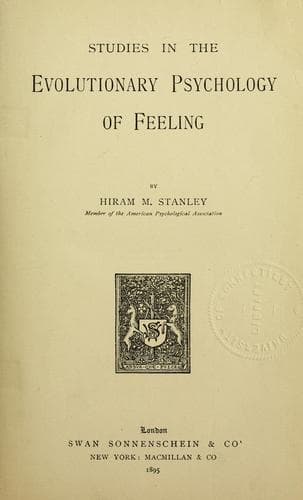
Studies in the Evolutionary Psychology of FeelingStanley, Hiram Miner
Philosophy
Studies in the Evolutionary Psychology of Feeling
Stanley, Hiram Miner
Emotions
The connecting once achieved of object with pain, it becomes
increasingly easy to cognize the feeling value of objects, and before
full and extreme pain experience therefrom to pre-react through emotion.
Thus emotion saves both direct pain and injury. As it becomes a
permanent tendency, and an impulse of consciousness to proceed from all
pure feelings to cognition of object, so also to cognition of object in
its feeling quality, and thus by inherent tendency it ultimately comes
about that there is attaching of pain to various objects cognized, even
when there is no immediate experience of pain to be connected therewith.
Finally the precedent inciting pains to cognition become such minor
factors, and knowledge arises with such apparent spontaneity, that
emotion as involving pain significance becomes dominant rather than the
immediate pain. An order of consciousness becomes established in which
the notable event is emotional cognition of experience values as
bringing in permanent emotion rather than an order of pleasure-pain
inciting cognition with evanescent emotion. But at the first it is
evident that fear was but a slight event in a consciousness which was
mainly absorbed in immediate pain experience and some sense of object.
It is so habitual and instinctive for us to perceive all things as
having feeling value, that it is most difficult to appreciate the
standpoint of a consciousness which is just attaining emotion life.
The preliminary elements to simple primitive fear, as expressed by any
such phrase as, “it hurts,” are at least four: pain, cognition of
object, cognition of the pain, cognition of the pain agency of object.
These operations, as being at first successive, do not necessarily
imply, however, sense of time. The consciousness of a pain is certainly,
at first, consciousness of pain really past, yet not consciousness of it
as past. The pain stands as immediately antecedent act to the
consciousness which is cognition of it, but sense of experience is not
thereby sense of experience in time. The sense of time-relations of
experiences is wholly subsequent to the simple sense of experience. All
experience is, of course, in time, but far from being of time.
Public-domain text, read in full here on John Shaqi.
Reviews
Reviews
No reviews yet
Be the first to share your thoughts on this work.
Elsewhere in the archive
Join the Discussion
Join the discussion
Sign in to leave a comment or review.
Sign InorCreate an account