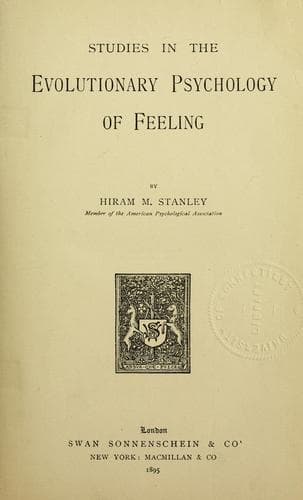
Studies in the Evolutionary Psychology of FeelingStanley, Hiram Miner
Philosophy
Studies in the Evolutionary Psychology of Feeling
Stanley, Hiram Miner
Emotions
While this primitive undifferentiated fear, which acts with the same
force and quality in all instances, confers upon the organism which
possesses it a great superiority over those which do not possess it, in
the race for life, and thus marks a great advance in psychical progress,
yet it is manifestly uneconomical in its action in that there should be
precisely the same amount and quality of reaction in all cases. So when
a considerable number of organisms had attained the power to fear,
competition would inevitably lead to some differentiation, and this
doubtless first in the direction of greater economy. The animal which
could fear much or little, according to the degree of actual injury
threatened, would have a great advantage in the struggle for existence
over his fellows. The amount of pain in prospect is definitely gauged,
and the fear pain becomes proportioned thereto, and so the will effort
and muscular exertions. Fear in its earliest form sets the whole motor
apparatus going at the highest rate, the whole organism is at the
highest pitch of activity, and life and death struggle happens at every
apprehension of pain, no matter how small the reality. Later, through
discrimination, animals become capable of either a slight scare or a
great fear, according to circumstances. The fear force is gradually
rationalized and made less spasmodic and so more adaptive. The fear pain
becomes proportioned to the real amount of pain and so to injury
actually imminent.
This mode of evolution by decrease rather than increase of intensity
may seem peculiar. Fear, however, certainly originates as a simple
outburst of considerable strength relative to the individual organism,
and the first step in fear growth is a development in the
representation-of-object element in fear which tends to reduce the
essence of fear as pain-emotion. Spasmodic primitive fear in becoming
intelligent loses intensity in the essential feeling aspect. Other
things being equal, the intensity of fear is inversely as the
definition of its object. The dimly and uncertainly known is always
thereby more fearful than the well known and familiar. However, as
regards primitive psychism, we must remark that all phenomena are very
large in relative quantity to individual capacity, but very small in
absolute psychological quantity. A fear which convulses a very small
mind would make but a very small disturbance in a mind of very great
capacity. An amount of fear which would absorb completely one
consciousness capacity, would require comparatively little force in a
mind of greater calibre. The lowest minds are possessed by their
fears, higher minds possess them, do not “lose their heads,” _i.e._,
both cognition and will co-exist as stable controlling elements.
Primitive consciousness is constantly at saturation point, phenomena
occur only in linear consecutive order, and every phenomenon is a
feeling-willing which absorbs the low conscious capacity. It may then,
Public-domain text, read in full here on John Shaqi.
Reviews
Reviews
No reviews yet
Be the first to share your thoughts on this work.
Elsewhere in the archive
Join the Discussion
Join the discussion
Sign in to leave a comment or review.
Sign InorCreate an account