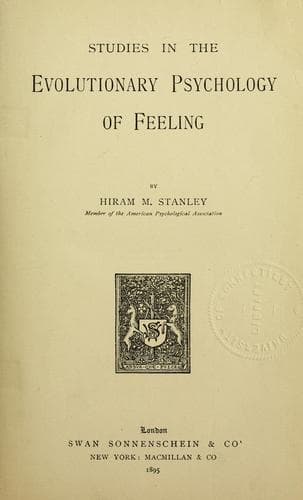
Studies in the Evolutionary Psychology of FeelingStanley, Hiram Miner
Philosophy
Studies in the Evolutionary Psychology of Feeling
Stanley, Hiram Miner
Emotions
perhaps, be regarded that the evolution of fear is not through
absolute decrease in intensity, but an increase of conscious capacity,
whereby greater definition of object becomes possible and coincident
with fear-pain of original quantity. The complete determination of
this question must then await a fuller analysis, but the relation to
individual capacity in the evolution of fear remains apparent.
Whatever may be the absolute quantity and intensity of the fear
phenomenon, its relative quantity and intensity changes very greatly.
The number of adaptive degrees of fear which are ultimately evolved and
of which any very high mind is susceptible, is quite beyond our present
means of psychological analysis. We have no phobometer to register all
the gradations, other than the popular usage of language, but between “I
was scared just the least bit,” and “I was scared stiff,” or “scared to
death,” there is certainly a vast number of intermediaries. Terror is an
intensive term denoting strong fear, and a terrible fright is a
redundancy for extreme fear. By the use of adjectives and various
qualifying phases we roughly denote a number of fear degrees, but
scientific precision is wholly lacking. Such expressions as “I have very
little fear of him,” “I fear him a little,” “I fear him greatly,” “I
fear him very much,” convey a meaning indeed, but no exact measurement
is indicated.
Terror is often used as a term not merely for fear in general, but for
fear which paralyzes by its force. The individual is often “rooted to
the spot” by terror, he loses all power of motion and becomes as an
inert mass. With animals even of the lower grades this is doubtless
often a pathological manifestation. We find that predatory animals are
often furnished with apparatus to inspire benumbing fear in their
victims. Various means, as inflation of size, strident noises, etc., are
employed with great effect. On the other hand, we find that predacious
animals seek to reduce the stimulus of fear in their victims by quieting
and alluring methods. Both hypertrophy and atrophy of fear are
disadvantageous, and we should see then in paralyzing terror an instance
of over-development of useful function which produces the direct
opposite of the normal fear. Fear, the great means of salvation to all
weaker organisms, is also in its highest intensities taken advantage of
by enemies. Hence the due graduation and restraint of fear becomes one
of the most important lines of mental evolution for the organism preyed
upon, but the over stimulation or undue weakening of the fear function
in its prey becomes a most important object and advantage for the
predacious animal. This evolution is often by the individual
disadvantageous variation when this is advantage to some other organism;
and, as living beings are soon divided into the two classes, those who
flee and those who pursue, the destroying and preserving of the chief
psychological defence becomes a leading form of psychic growth of a
Public-domain text, read in full here on John Shaqi.
Reviews
Reviews
No reviews yet
Be the first to share your thoughts on this work.
Elsewhere in the archive
Join the Discussion
Join the discussion
Sign in to leave a comment or review.
Sign InorCreate an account