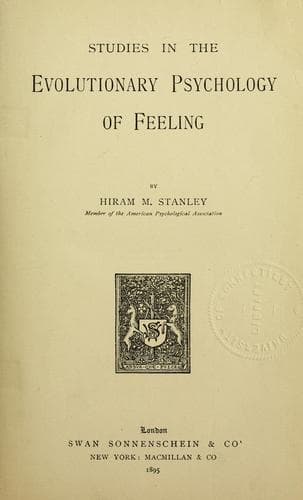
Studies in the Evolutionary Psychology of FeelingStanley, Hiram Miner
Philosophy
Studies in the Evolutionary Psychology of Feeling
Stanley, Hiram Miner
Emotions
A very important differentiation of fear is brought about by the
extension of the time sense. Fear begins with a _minimum_ of time sense;
only the immediately impending, the absolutely imminent danger, suffices
to awaken fear. But in the struggle for existence the advantage of being
influenced for action by the more and more remote, in time, determines a
rapid extension in time to feared events. With man actions are thus
influenced by fears, which reach even beyond the present life. The
cautious and prudent are those whose fears are far-sighted, and who,
conducting themselves accordingly, maintain supremacy over the
short-sighted and improvident. _Carpe diem_ is, from the point of view
of evolutionary psychology, the cry of the retrogressive fool.
The time differentiation of fear is recognised in popular language in
the term—dread. I am frightened in the night by a sudden noise; I am
alarmed for the safety of a child awaking near a precipice; but I dread
next week’s task. Of course dread, like other popular psychological
terms, is plastic, and often denotes fear in general, and is often used
intensively, or to denote vague fear, still it is the most correct and
distinctive term for fear of a more or less remote event. It would be
most interesting to investigate the relation of distance in time of
feared event to intensity of the fear, but we have as yet no standards
for estimating in mathematical ratios either time or intensity
psychologically considered. It is not, of course, physical determination
of time as minutes, hours, etc., with which we are concerned, but only
with variations in sense of nearness or remoteness of event. Our sense
of time is most variable, and fluctuates from many causes, so that hours
sometimes seem minutes, and minutes at other times seem hours. However,
there is, doubtless, other things being equal, some fixed relation
between our sense of the nearness and remoteness of a fearful event and
the intensity of the fear, but we may well doubt whether it can ever be
reduced to any law of inverse squares like that of physical intensities.
A criminal sentenced to die at the expiration of thirty days certainly
has a marked increase in fear as time approaches, or rather, as he has
sense of the time approaching, but a quantitative analysis is beyond our
present powers.
Public-domain text, read in full here on John Shaqi.
Reviews
Reviews
No reviews yet
Be the first to share your thoughts on this work.
Elsewhere in the archive
Join the Discussion
Join the discussion
Sign in to leave a comment or review.
Sign InorCreate an account