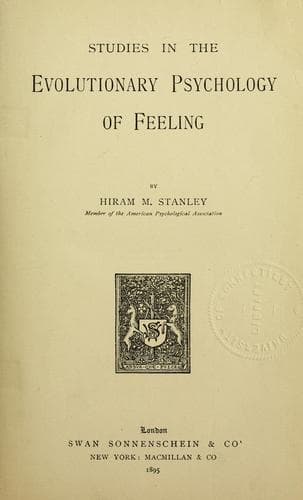
Studies in the Evolutionary Psychology of FeelingStanley, Hiram Miner
Philosophy
Studies in the Evolutionary Psychology of Feeling
Stanley, Hiram Miner
Emotions
A most important but tolerably late differentiation is the altruistic
form of fear—fear, not of others, but for others. Psychic life is at
first wholly self-centred, there is no perception of things or interest
in them otherwise than as bearing on the experience of the self. Other
selves are wholly unrecognised, and pain-giving effects to them are then
unperceivable. In very young infants we see a close approximation to
primitive selfish life. The exact point in the history of life when
altruism is developed by the struggle of existence is not at present
determinable, but we may well believe that it arose with the evolution
of the sexes in separate individuals. Fear for mate and offspring is
obviously an essential advantage in the progress and perpetuation of the
kind. Pure altruism is not at first attained, and there is only the
faintest gleam of appreciation of pain-states in others, and genuine
feeling therefor. The sexual appetite is, like other appetites, purely
selfish at first, and the animal fears the loss of what will satisfy in
an individualistic way, quite as he fears that food may be taken away or
destroyed. Even in higher psychisms much that we readily interpret as
altruistic is often mainly personal; it is not a true regard and emotion
at pain and injury imminent to others, a manifestation of feeling at
their experience as such, but mostly a feeling for their experience only
so far as it involves our pleasure-pain. When sociality and
interdependence of organisms is attained as a great advantage in the
struggle of life, when personal experience is perceived as dependent
upon experiences of others, then a feeling value attaches to the
experienceable for others, yet selfishly at first. Even parental
oversight and care must originally have been selfish—the satisfaction of
a personal craving, rather than the promotion of the well-being of
another, considered for its own sake. Real and pure altruism must,
indeed, be accounted, even in human society, as a rare phenomenon,
perfect self-forgetfulness being almost impossible even for the most
developed consciousness, owing to the strength and persistence of an
indefinite heredity of selfishness. Fear for others is, then, in truth,
merely an indirect fear for ourselves; and particularly so is this true
in all lower consciousness. But we must acknowledge that elements of
real altruism do enter and do grow in value and strength in the
evolution of consciousness, and we must, if we adhere strictly to the
principle of personal advantage as determining evolution, find a reason
here for a singular and seemingly incompatible manifestation. Regard for
the good of others is not always indirectly regard for personal good,
and self-sacrifice is certainly an element in psychic life, even in
lower consciousness, where we often seem to see a distinct struggle
between egoistic fear and altruistic fear, as in animals protecting
their young. But we see the same in an animal defending food from being
Public-domain text, read in full here on John Shaqi.
Reviews
Reviews
No reviews yet
Be the first to share your thoughts on this work.
Elsewhere in the archive
Join the Discussion
Join the discussion
Sign in to leave a comment or review.
Sign InorCreate an account