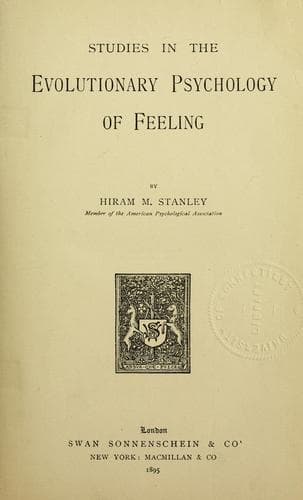
Studies in the Evolutionary Psychology of FeelingStanley, Hiram Miner
Philosophy
Studies in the Evolutionary Psychology of Feeling
Stanley, Hiram Miner
Emotions
acquired by its enemies.
Advantage for the race is certainly gained, but this wholly
unconsciously; and it plays no part in the actual psychism of the
individual. In a highly social, which is also in the most effective and
advantageous mode of life, it is certain that the purely self-seeking
will be at a disadvantage in general, whereas those who give themselves
up to help others are by others so helped, that the final _status_ of
the individual is higher and better than if he had been wholly a
self-seeker. However, he who, perceiving this law, sets out to be
altruistic for his own ends, invariably suffers defeat in the long run,
for entire disinterestedness can alone avail. But the problem of
altruism, from an evolutionary point of view, cannot here be further
remarked on; a fuller discussion would lead us too far afield. However,
we are convinced that altruism springs up and grows like the other
elements of psychic life, as functional in the largest way to the
demands of life in the struggle for existence.
Horror is a distinctive term for altruistic fear. When on a train, I am
_terrified_ if I perceive a collision imminent and inevitable, but as a
mere spectator walking near the tracks, I am _horrified_ by the prospect
of a collision. One may be “in mortal terror,” but not in mortal horror.
Our sense of the feelings of others towards us, whether they be egoistic
or altruistic, determines a large class of reflex emotions which are
often very subtle. If we perceive that some one is fearing us or fearing
for us there is immediate reaction on our part. Feeling response to
feeling acts and reacts in a multitude of complex ways, as we cannot but
observe when in the company of very “sensitive” people. The “sensitive”
one is he whose emotional life is governed by his perception of the
feelings of others toward himself, and he becomes wonderfully responsive
to the least expressions of emotion toward himself. The delicate
responsiveness of women, their intuitions, are merely quick
perceptiveness of emotion expression. The fears of such are largely
concerned with this dependence on the emotional attitudes of others
toward themselves; they fear to incur displeasure, they fear loss of
love, etc. Thus psychical phenomena become more and more determined by
psychical phenomena as interpreted and considered with reference to the
self. Panic is contagious fear, and has originated and been developed as
securing mutual safety in societies of animals. However, there is less
real fear on occasions of panic than is often supposed, for much of the
expression which we read as fear inspired is really merely imitative,
and does not signify any real basis of emotion. Moreover, we must note
that there is no direct contagion, but the perception of fear in others
merely leads us to dimly body forth some fearful events as impending,
which representation involves the full phenomenon of fear. There is also
Public-domain text, read in full here on John Shaqi.
Reviews
Reviews
No reviews yet
Be the first to share your thoughts on this work.
Elsewhere in the archive
Join the Discussion
Join the discussion
Sign in to leave a comment or review.
Sign InorCreate an account