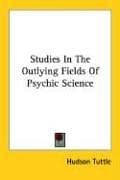
Studies in the Out-Lying Fields of Psychic ScienceTuttle, Hudson
Religion
Studies in the Out-Lying Fields of Psychic Science
Tuttle, Hudson
Parapsychology
HALLUCINATIONS.--The received definition of an hallucination is a false
perception without any material basis, being formed entirely in the
mind. An individual who sees pictures on a blank wall, or who hears
voices when no sound reaches his ear, is hallucinated. “The reason for
this being that the erroneous perception constituting the hallucination
is found in that part of the brain which ordinarily requires the
excitation of sensorial impressions for its functions.” In this view,
hallucination is evidence of mental derangement and incipient insanity.
This explanation is by no means sufficient for this class of facts. That
a certain tract of brain can of itself give the mind complicated
representations, never before seen or imaged in the mind, is not
established. The reappearance of objects that have been seen is better
explained, and still more satisfactorily, by causes which unite them all
together, and with all like phenomena. George Combe says of a painter
who inherited much of the patronage of Sir Joshua Reynolds, and believed
himself to possess a talent superior to his, was so fully engaged that
he had painted three hundred large and small portraits in one year. The
fact appeared physically impossible, but the secret of his rapidity and
astonishing success was this: He required but one sitting of his model.
His method was as follows, as given by himself: “When a sitter came, I
looked attentively on him for half an hour, sketching from time to time
on the canvas. I did not require a longer sitting. I removed the canvas,
and passed to another person. When I wished to continue the first
portrait, I recalled the man to my mind. I placed him on the chair,
where I perceived him as distinctly as though really there, and, I may
add, in form and color more decidedly brilliant. I looked from time to
time at the imaginary figure and went on painting, occasionally stopping
to examine the picture exactly as though the original was before me;
whenever I looked towards the chair I saw the man. This method made me
very popular, and as I always caught the resemblance, the sitters were
delighted that I spared them the annoying sittings of other painters.”
This painter was far from incipient insanity. He was sensitive to
impressions, and able by that organization to recall the image of the
sitter, but not that of one who had not occupied the chair.
Public-domain text, read in full here on John Shaqi.
Reviews
Reviews
No reviews yet
Be the first to share your thoughts on this work.
Join the Discussion
Join the discussion
Sign in to leave a comment or review.
Sign InorCreate an account