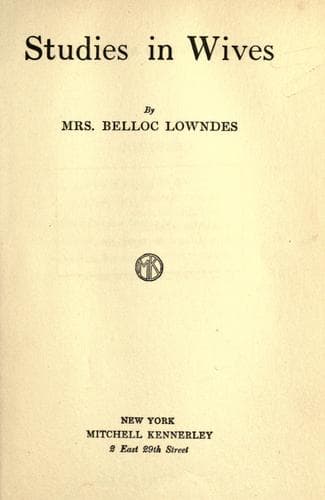
Marriage -- Fiction; Short stories, English; Wives -- Fiction
This matter nearest Mr. Bustard's heart concerned his two younger
brothers and an orphan sister whom he supremely desired to do the best
for, and to set well forward in life.
It was of these three young people that he and Althea almost always
talked, and if Althea allowed herself to have an ardent wish, it was
that her husband would permit her to invite Mr. Bustard's sister for a
few weeks when the girl left the German finishing school which she and
Mr. Bustard had chosen, after much anxious deliberation, a year before.
It soothed Althea's sore heart to know that there was at least one
person in her husband's circle who thought well of her judgment, who
trusted in her discretion, and who did her the compliment of not only
asking, but also of taking her advice.
John Bustard had formed a very good opinion of Althea, and,
constitutionally incapable of divining the causes which had determined
the choice of Scrope's wife, he considered Mrs. Scrope a further proof,
if indeed proof were needed, of his brilliant schoolfellow's acute
intelligence. He had ventured to say as much to Scrope's late official
chief, one of the few men to whom Mr. Bustard, without a sufficient
cause, would have mentioned a lady's name. But he had been taken aback,
rather disturbed, by the old statesman's dry comment: "Ay, there's
always been method in Scrope's madness. I agree that he has made, from
his own point of view, a very good marriage."
His wife's friendship with Mr. Bustard did not escape Perceval Scrope's
ironic notice. He affected to think his old schoolfellow a typical
member of the British public, and he had nicknamed him "the
Bullometer," but, finding that his little joke vexed Althea, he had,
with unusual consideration, dropped it.
Unfortunately the one offensive epithet was soon exchanged for another;
in allusion doubtless to some historical personage of whom Althea had no
knowledge, Scrope began to call Bustard her fat friend. "How's your fat
friend?" he would ask, and a feeling of resentment filled Althea's
breast. It was not John Bustard's fault that he had a bad figure; it was
caused by the sedentary nature of his work, and because, instead of
spending his salary in the way most civil servants spend theirs, that is
in selfish amusements, he spent it on his younger brothers, and on his
little sister's education.
* * * * *
Althea again went over to the window and looked out. It had now left off
snowing, and the mists were gathering over the park. Soon a veil of fog
would shut out the still landscape. If Mr. Bustard were coming this
afternoon she hoped he would come soon, and so be gone before Perceval
came in.
Public-domain text, read in full here on John Shaqi.
Reviews
Reviews
No reviews yet
Be the first to share your thoughts on this work.
Join the Discussion
Join the discussion
Sign in to leave a comment or review.
Sign InorCreate an account