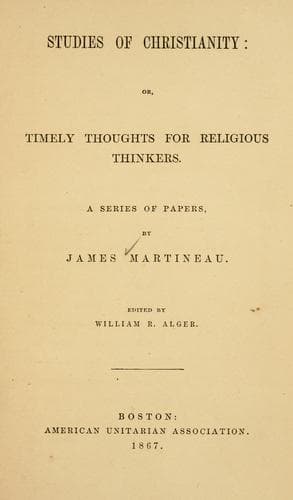
Studies of Christianity; Or, Timely Thoughts for Religious ThinkersMartineau, James
Religion
Studies of Christianity; Or, Timely Thoughts for Religious Thinkers
Martineau, James
Christianity; Church history -- 19th century
To conduct the pleadings--still more
to pronounce the judgment--there, other habits of mind are needed than
are required in the museum and the observatory; and the history of
knowledge, past and present, abounds with instances of men who, with
the highest merit in particular walks of science, have combined a
curious incompetency of survey over the whole. Hence, very few natural
philosophers, however eminent for great discoveries and dreaded by the
priesthood of their day, have made any deep and durable impression on
the religious conception of the universe, as the product and
expression of an Infinite Mind; and in tracing the eras of human
faith, the deep thinker comes more prominently into view than the
skilful interrogator of nature. In the history of religion, Plato is a
greater figure than Archimedes; Spinoza than Newton; Hume and Kant
than Volta and La Place; even Thomas Carlyle than Justus Liebig. Our
picture indeed of the system of things is immensely enlarged, both in
space and duration, by the progress of descriptive science; and the
grouping of its objects and events is materially changed. But the
altered scene carries with it the same expression to the soul; speaks
the same language as to its origin; renews its ancient glance with an
auguster beauty; and, in spite of all dynamic theories, reproduces the
very modes of faith and doubt which belonged to the age both of the
old Organon and of the new.
The ultimate problem of all philosophy and all religion is this: "How
are we to conceive aright the origin and first principle of things?"
The answers, it has been contended by a living author of distinguished
merit, are necessarily reducible to two, between which all systems are
divided, and on the decision of whose controversy, all antagonist
speculations would lay down their arms. "In the beginning was FORCE,"
says one class of thinkers; "force, singular or plural, splitting into
opposites, standing off into polarities, ramifying into attractions
and repulsions, heat and magnetism, and climbing through the stages of
physical, vital, animal, to the mental life itself." "On the
contrary," says the other class, "in the beginning was THOUGHT; and
only in the necessary evolution of its eternal ideas into expression
does force arise,--self-realizing thought declaring itself in the
types of being and the laws of phenomena." We need hardly say, that
the former of these two notions coalesces with the creed of Atheism,
and is most frequently met with upon the path of the physical
sciences, while the latter is favored by the mathematical and
metaphysical, and gives the essence of Pantheism. Each of them has
insurmountable difficulties, with which it is successfully taunted by
the other. Start from blind force; and how, by any spinning from that
solitary centre, are we ever to arrive at the seeing intellect? Can
the lower create the higher, and the unconscious enable us to think?
Start from pure thinking, and how then can you get any force for the
Public-domain text, read in full here on John Shaqi.
Reviews
Reviews
No reviews yet
Be the first to share your thoughts on this work.
Join the Discussion
Join the discussion
Sign in to leave a comment or review.
Sign InorCreate an account