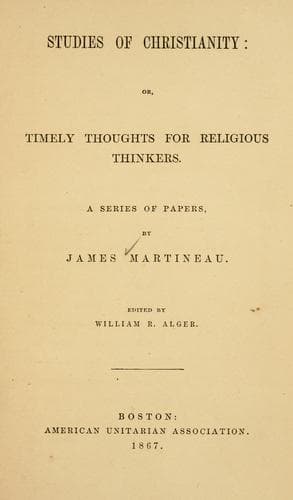
Studies of Christianity; Or, Timely Thoughts for Religious ThinkersMartineau, James
Religion
Studies of Christianity; Or, Timely Thoughts for Religious Thinkers
Martineau, James
Christianity; Church history -- 19th century
To lose sight of this principle in estimating Christianity, and to
insist on judging it, not by its matured character in Christendom, not
by the _unconscious spirit_ of its founders, but by their personal
views and purposes, is to overlook the divine in it in order to fasten
on the human; to seek the winged creature of the air in the throbbing
chrysalis; and is like judging the place of the Hebrews in history by
the court and the proverbs of Solomon, or the value of Puritanism by
the sermon of a hill-preacher before the civil war. The primitive
Christianity was certainly _different_ from that of other ages; but
there is no reason for believing that it was _better_. The
representation often made of the early Church, as having only truth,
and feeling only love, and living in simple sanctity, is contradicted
by every page of the Christian records. The Epistles are entirely
occupied in driving back guilt and passion, or in correcting errors of
belief; nor is it _always_ possible to approve of the temper in which
they perform the one task, or to assent to the methods by which they
attempt the other. Principles and affections were indeed secreted in
the heart of the first disciples, which were to have a great future,
and to become the highest truth of the world. But it was precisely of
these that they rarely thought at all. The Apostles themselves speak
slightingly of them, as baby's food; and the great faith in God, the
need of repentant purity of heart, with the trust in immortality,--the
very doctrines which we should name as the permanent essence of
Christian faith,--are expressly declared by them to be the childish
rudiments of belief, on which the attention of the grown Christian
will disdain to dwell. And what did they prefer to these sublime
truths, as the nutriment of their life and the pride of their wisdom?
Allegories about Isaac and Ishmael, parallels between Christ and
Melchisedec, new readings of history and prophecy to suit the events
in Palestine, and a constant outlook for the end of all things. These
were the grand topics on which their minds eagerly worked, and on
which they labored to construct a consistent theory. These give the
form to their doctrine, the matter to their spirit. These are what you
will get, if you go indiscriminately to their writings for a creed:
and these are no more Christianity than the pretensions of Hildebrand
or the visions of Swedenborg. The true religion lies elsewhere, just
in the things that were _ever present with them, but never esteemed_.
Just as your friend may spend his anxiety on his station, his
usefulness, his appearance and repute, and fear lest he should show
nothing deserving your regard, while all the time you love him for the
pure graces, the native wild-flowers, of his heart; so do the
choicest servants of God ever think one thing of themselves, while
they are dear to him and revered by us for quite another. "The weak
things" in the Church not less than in "the world hath he chosen to
Public-domain text, read in full here on John Shaqi.
Reviews
Reviews
No reviews yet
Be the first to share your thoughts on this work.
Join the Discussion
Join the discussion
Sign in to leave a comment or review.
Sign InorCreate an account