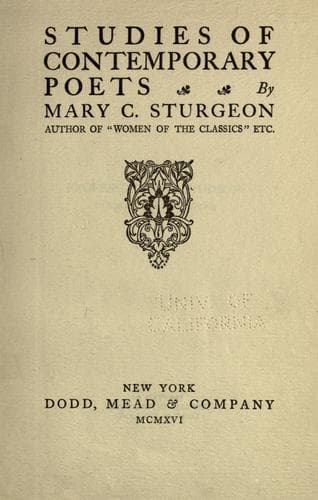
English poetry -- 20th century -- History and criticism
Out of the lives of heroes and their deeds,
Out of the miracle of human thought,
Out of the songs of singers, God proceeds;
And of the soul of them his Soul is wrought.
There follows a quick clatter of disputation, broken by the entrance of
the philosopher; and the pilgrim's question being put to him, he
replies--
God? God! There is no GOD.
Thus 'the spirit that denies' abruptly shatters the poetic vision; and
the artistic effect is, correspondingly, to break the music of the
previous stanzas with a sudden discord. The design of the work required
that the philosopher should be heard, and dramatic fitness suggested
that his most effective entrance would be here, rending the fair new
synthesis with denial. And the resulting dissonance is inherent in the
very scheme of the poem.
That defect does not appear in "The Last Abbot," which is also engaged
upon the thought of the universal soul. Here an old monk, knowing that
he is drawing near the end of life, quietly talks to the brethren of his
order about life and death and after-death. There is no argument, no
discussion even. No other voice is raised to interrupt the meditative
flow of the old man's message, which is, in fact, a recantation. And, as
a consequence, the poem has a unity of serene reflectiveness, rising at
times to lyrical ecstasy. He is thinking of his approaching death--
Oh, I, with light and airy change,
Across the azure sky shall range,
When I am dead.
.....
I shall be one
Of all the misty, fresh and healing powers.
Dew I shall be, and fragrance of the morn,
And quietly shall lie dreaming all the noon,
Or oft shall sparkle underneath the moon,
A million times shall die and be reborn,
Because the sun again and yet again
Shall snatch me softly from the earth away:
I shall be rain;
I shall be spray;
At night shall oft among the misty shades
Pass dreamily across the open lea;
And I shall live in the loud cascades,
Pouring their waters into the sea.
... Nought can die:
All belongs to the living Soul,
Makes, and partakes, and is the whole,
All--and therefore, I.
Public-domain text, read in full here on John Shaqi.
Reviews
Reviews
No reviews yet
Be the first to share your thoughts on this work.
Elsewhere in the archive
Join the Discussion
Join the discussion
Sign in to leave a comment or review.
Sign InorCreate an account