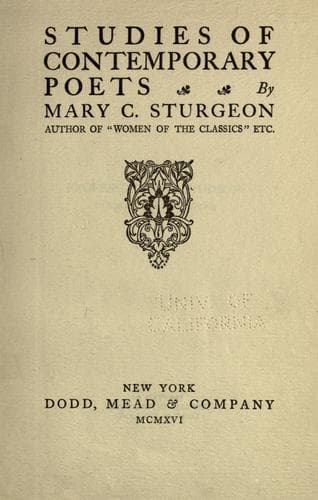
English poetry -- 20th century -- History and criticism
I do not wish, to stress unduly the spiritual element in this work, but
it compels attention for two reasons. It is a dominant impulse,
supplying themes which occur early and late and often; and the manner of
its expression reveals a link with the past generation which is
analogous to the technical connexion that we have already noted.
The signs of descent from the Victorians are naturally to be found in
the early poems. There is, for example, the inevitable classic theme
treated in the (also inevitable) romantic manner, and making a charming
combination, despite the grumblings of the realist and the pedant. That,
however, is a very obvious and external mark of descent. A more
interesting sign is in the spirit of "A Song at Dawn," a wail to the
Power of Powers which the author probably wishes to forget. So I will
not quote it. The point about it is the celerity with which it sends
thought flying back to Matthew Arnold and "Dover Beach." Yet there is an
important difference. For whilst the Victorian muses upon the decay of
faith with exquisite mournfulness, the 'Georgian' takes an attitude of
greater detachment. Instead of grieving for a dead or dying system of
theology, he seeks to question the reality which lies behind it.
In the volume of 1911, called _Before Dawn_, there are several poems
which pursue the same quest. Sometimes the method is one of provocative
directness, as in the dramatic piece called "God"; and at other times it
is by way of symbol or suggestion, as in "Moon-worshippers" or "Two
Visions." From the nature of things, however, the pieces in which the
argumentative attitude is taken are the less satisfying, as poetry. Thus
the colloquy in "God" just fails, from the polemical theme, of being
truly dramatic; while, on the other hand, its form prevents it from
rising into such lovely lyrism as that of "The Last Abbot." In the
former poem we are to imagine all sorts and conditions of people coming
in and out of an old English tavern on market day; and all of them ready
and willing to enlighten a travel-stained pilgrim there as to "Who and
what is God?" One sees the allegory, of course; but, somehow, that is
less convincing than the touches of satirical portraiture which we find
in passing, and which point to this poet's gift of objectivity. The
judge and the priest, the soldier and sailor and farmer, the beggar,
thief and merchant, are presented mainly as types: that, of course,
being demanded by the allegory. And when a poet arrives to solve the
problem, he also speaks 'in character'--though we recognize the voice
for one more modern than his reputed age.
... God is a spirit, not a creed;
He is an inner outward-moving power:
.....
He is that one Desire, that life, that breath,
That Soul which, with infinity of pain,
Passes through revelation and through death
Onward and upward to itself again.
Public-domain text, read in full here on John Shaqi.
Reviews
Reviews
No reviews yet
Be the first to share your thoughts on this work.
Elsewhere in the archive
Join the Discussion
Join the discussion
Sign in to leave a comment or review.
Sign InorCreate an account