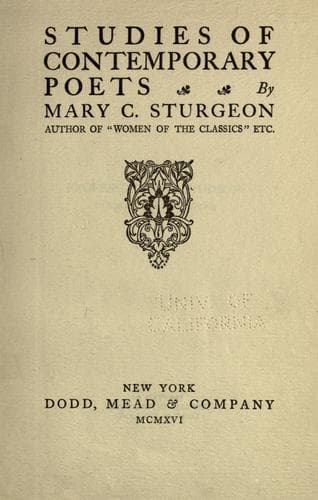
English poetry -- 20th century -- History and criticism
Even here, however, the effect is gained by colour and movement; by the
grouping of images rather than by the development of an idea; and that
will be found to be Mrs Naidu's method in the many delightful lyrics of
these volumes where she is most successful. The "Folk Songs" of her
first book are an example. One assumes that they are early work, partly
because they are the first group in the earlier of the two volumes; but
more particularly because they adopt so literally the advice which Mr
Edmund Gosse gave her at the beginning of her career. When she came as a
girl to England and was a student of London University at King's
College, she submitted to Mr Gosse a bundle of manuscript poems. He
describes them as accurate and careful work, but too derivative;
modelled too palpably on the great poets of the previous generation.
His advice, therefore, was that they should be destroyed, and that the
author should start afresh upon native themes and in her own manner. The
counsel was exactly followed: the manuscript went into the wastepaper
basket, and the poet set to work on what we cannot doubt is this first
group of songs made out of the lives of her own people.
There is all the hemisphere between these lyrics and those of
late-Victorian England. Here we find a "Village Song" of a mother to the
little bride who is still all but a baby; and to whom the fairies call
so insistently that she will not stay "for bridal songs and bridal cakes
and sandal-scented leisure." In the song of the "Palanquin Bearers" we
positively see the lithe and rhythmic movements which bear some Indian
beauty along, lightly "as a pearl on a string." And there is a song
written to one of the tunes of those native minstrels who wander, free
and wild as the wind, singing of
The sword of old battles, the crown of old kings,
And happy and simple and sorrowful things.
The "Harvest Hymn" raises thanksgiving for strange bounties to gods of
unfamiliar names; and the "Cradle Song" evokes a tropical night, heavy
with scent and drenched with dew--
Sweet, shut your eyes,
The wild fire-flies
Dance through the fairy _neem_;
From the poppy-bole,
For you I stole
A little, lovely dream.
Public-domain text, read in full here on John Shaqi.
Reviews
Reviews
No reviews yet
Be the first to share your thoughts on this work.
Elsewhere in the archive
Join the Discussion
Join the discussion
Sign in to leave a comment or review.
Sign InorCreate an account