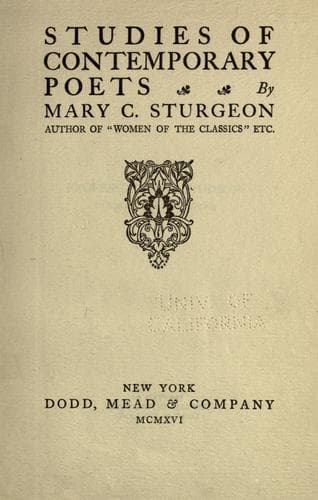
English poetry -- 20th century -- History and criticism
In its lightness and grace, this poem is one of the exquisite things in
our language: one of the little lyric flights, like William Watson's
"April," which in their clear sweetness and apparent spontaneity are
like some small bird's song. Mrs Naidu has said of herself--"I sing just
as the birds do"; and as regards her loveliest lyrics (there are a fair
proportion of them) she speaks a larger truth than she meant. Their
simplicity and abandonment to the sheer joy of singing are infinitely
refreshing; and fragile though they seem, one suspects them of great
vitality. In the later volume there is another called "Golden
Cassia"--the bright blooms that her people call mere 'woodland flowers.'
The poet has other fancies about them; sometimes they seem to her like
fragments of a fallen star--
Or golden lamps for a fairy shrine,
Or golden pitchers for fairy wine.
Perchance you are, O frail and sweet!
Bright anklet-bells from the wild spring's feet,
Or the gleaming tears that some fair bride shed
Remembering her lost maidenhead.
The tenderness and delicacy of verse like that might mislead us. We
might suppose that the qualities of Mrs Naidu's work were only those
which are arbitrarily known as feminine. But this poet, like Mrs
Browning, is faithful to her own sensuous and passionate temperament.
She has not timidly sheltered behind a convention which, because some
women-poets have been austere, prescribes austerity, neutral tones, and
a pale light for the woman-artist in this sphere. And, as a result, we
have all the evidence of a richly-dowered sensibility responding frankly
to the vivid light and colour, the liberal contours and rich scents and
great spaces of the world she loves; and responding no less warmly and
freely to human instincts. Occasionally her verse achieves the
expression of sheer sensuous ecstasy. It does that, perhaps, in the two
Dance poems--from the very reason that her art is so true and free. The
theme requires exactly that treatment; and in "Indian Dancers" there is
besides a curiously successful union between the measure that is
employed and the subject of the poem--
Their glittering garments of purple are burning like tremulous dawns
in the quivering air,
And exquisite, subtle and slow are the tinkle and tread of their
rhythmical, slumber-soft feet.
The love-songs, though in many moods, are always the frank expression of
emotion that is deep and strong. One that is especially beautiful is the
utterance of a young girl who, while her sisters prepare the rites for a
religious festival, stands aside with folded hands dreaming of her
lover. She is secretly asking herself what need has she to supplicate
the gods, being blessed by love; and again, in the couple of stanzas
called "Ecstasy," the rapture has passed, by its very intensity, into
pain.
Public-domain text, read in full here on John Shaqi.
Reviews
Reviews
No reviews yet
Be the first to share your thoughts on this work.
Elsewhere in the archive
Join the Discussion
Join the discussion
Sign in to leave a comment or review.
Sign InorCreate an account