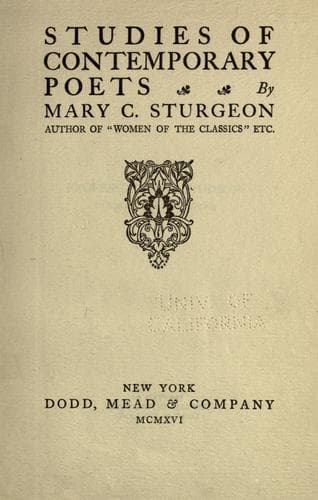
English poetry -- 20th century -- History and criticism
There are very few of those who are making genuine poetry, who are
content simply to sing. Indeed, it hardly seems to be a matter of
choice, but an urgency, secret and compelling as a natural instinct, by
means of which life is commanding expression in literary art. This is
not to suggest, however, that no lyrics are being composed. Current
poetry often reveals a true lyrical gift, especially in early work; and
so long as poets continue to be born young, we shall not lack for songs.
We may find, too, a rare singer like W. H. Davies, for whom genius,
temperament and circumstance have effected a happy isolation from the
complexity of modern existence. Owing allegiance chiefly to nature, he
is free as the air in body and soul. Unspoilt by books, and saving his
spirit humane and merry and sweet from the petty constraints of
civilization, he carols as lightly as a robin or a thrush. But he is
almost a solitary exception, and may serve to prove the rule that the
pure lyric--some intimate emotion bubbling over into music--cannot say
all that demands to be said when the poetic spirit is completely in
touch with life.
Now, in all the most vital of this modern verse, poetry has come so
close to life as to claim its very identity. It has left the twilight of
unreality and stepped into clear day. It has broken down the
exclusiveness which penned it within a prescribed circle of theme and of
language; and it has taken hold upon the world, real and entire.
Moreover, the life upon which it seizes in this way is wider, more
complex, more meaningful and varied than ever before. Political and
social changes have made humanity a larger thing--whether regarded in
the actual numbers which democracy thus brings within the poetic ken, or
in their manifold significance. Horizons, both mental and material, have
been extended. Science presses on in quiet confidence, the dogmatic
phase being over; and its methods as well as its data pass readily into
the collective mind. Religion, no longer synonymous with a single creed
or form of worship, can find room within itself for all the spiritual
activity of mankind everywhere; and in the juster proportion thus
attained, nobler syntheses are shaping. A constructive social sense
replaces the old negative commands with a positive duty of service.
Values are changing; new ideals quicken, struggle and fructify; fresh
aspects of life, and visions of human destiny, are opened up; while in
every sphere the spirit of inquiry and the experimental method generate
an energy of conflict which the timid and the sleepy loathe, but which
is nevertheless the dynamic of progress.
Public-domain text, read in full here on John Shaqi.
Reviews
Reviews
No reviews yet
Be the first to share your thoughts on this work.
Elsewhere in the archive
Join the Discussion
Join the discussion
Sign in to leave a comment or review.
Sign InorCreate an account