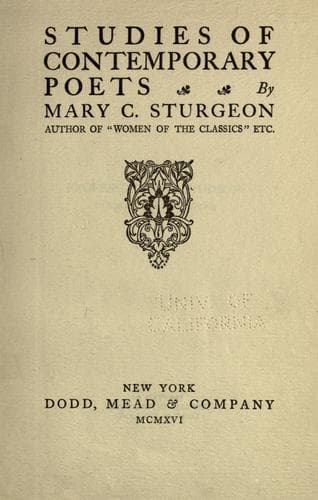
English poetry -- 20th century -- History and criticism
The poetry of to-day is the very spirit of that multiform life, giving
shape and permanence to whatever is finest in it; and for that reason
its manner of expression is almost infinitely varied, and often very
different from the poetic forms of other ages. That, indeed, is one sign
of its vitality: the fact that it is a living organism, capable of
adaptation, growth and development. Old forms are modified and new ones
created to embody the new ideas. All the resources of prosody are drawn
upon--when they will serve--and used with the utmost freedom. And when,
as frequently happens, they will not serve; when the established rules
of English verse seem inadequate to the present task, they are
challenged and thrown aside. Thus there arises, in the technique of
poetry itself, a corresponding conflict to that in the world of ideas,
indicating a similar vigour and equally prophetic of advance.
In all this variety, however, the dramatic element is a fairly constant
feature; and it seems to be growing stronger. It is present in many
poems which do not look like drama at all, as for instance in the
narratives of Mr Masefield. Here we may find vividly dramatic scenes,
astonishingly evolved in the form of an elaborate stanza, or the rhymed
couplet; just as the tragedies in _Daily Bread_ by Mr Gibson are wrought
out in a quite original unrhymed verse of extreme austerity. Again, much
of Mr Abercrombie's work is dramatic in essence, apart from his plays in
regular form; and Mrs Woods has completed a third poetical drama, having
already published two tragedies in her collected edition.
But there is one fact to be noted in coming from those poets to the
drama of "John Presland." With them the dramatic impulse is often
subconscious, and it has to fight its way, obscurely sometimes, against
a twin impulse towards lyricism. It is strong but not yet dominant;
vital, but not yet aware of its own potentiality. It throbs below the
surface of alien forms, but it rarely breaks away to an independent
existence. And even when it achieves consciousness, as it does most
completely perhaps in the work of Mrs Woods, traces of the struggle
cling about it still--in a lyrical _motif_, or a fragment of song
embedded in the structure of a play, or in a lyric intensity of feeling.
With "John Presland," however, the general tendency is reversed. The
dramatic impulse has become a definite and prevailing purpose, with the
lyrical element subordinated to it; and, as a consequence, we have here
a drama of full stature, a complete, organic, and acutely conscious
art-form.
Public-domain text, read in full here on John Shaqi.
Reviews
Reviews
No reviews yet
Be the first to share your thoughts on this work.
Elsewhere in the archive
Join the Discussion
Join the discussion
Sign in to leave a comment or review.
Sign InorCreate an account