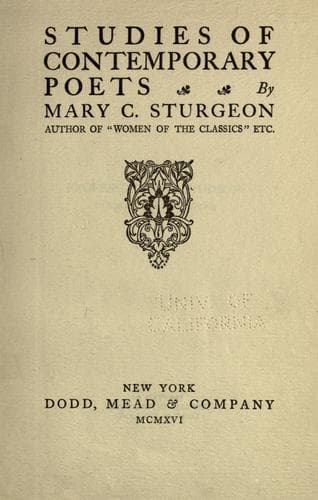
English poetry -- 20th century -- History and criticism
Through the door
The King has hurled the dagger, holds
His son against his breast, and pain
Contorts him, like a smitten oak;
Then sets the child upon the floor,
And rises, and undoes the clasp
Of his great mantle (like a stain
Of blood it lies about his feet).
Next from his head he takes the crown,
Holds it arm's-length, and drops it down
Suddenly, from his loosened grasp,
And for the third time goes he forth,
Bare-footed as a penitent,
Humble, and excommunicate,
To stand all day in falling snow
Outside Canossa's guarded gate,
Till Hildebrand shall mercy show.
The dramatic sense is clearly operative there. Here is an instinct which
perceives the kinetic values of things; which seizes unerringly upon the
stuff of drama, and, contemplating a character, an event or a situation,
feels it start into life under the touch and sees it move forward and
rush to a crisis before the eyes. In the lyrics this quality is often
merely latent; but in the plays it has come to full power and has found
expression through its own proper medium. It is, of course, the
originating impulse of drama as well as the force that shapes it; and if
we would take some measure of this creative energy in our poet, we have
only to observe that all of his five plays were published in five years,
one play to each year. The first, _Joan of Arc_, appeared in 1909; the
last, _Belisarius_, came out in 1913; the other three, _Mary Queen of
Scots_, _Manin_, and _Marcus Aurelius_, belong respectively to the three
intervening years. And there is another ready, representing 1914!
Moreover, they are all fully developed and of rather elaborate
structure. Being poetic and historical drama, perhaps it is natural that
they should follow the Shakespearean model, though their dependence on
tradition is a curious fact at this time of day. _Joan of Arc_ and _Mary
Queen of Scots_ are both of five-act length, and the rest are of four
acts. Numerous characters are introduced and a great deal of material is
handled: incident is plentiful, situations vary and scenes change with
some frequency; while underplot and crossaction bring in interests which
are additional to, though subserving, the main theme.
Public-domain text, read in full here on John Shaqi.
Reviews
Reviews
No reviews yet
Be the first to share your thoughts on this work.
Elsewhere in the archive
Join the Discussion
Join the discussion
Sign in to leave a comment or review.
Sign InorCreate an account