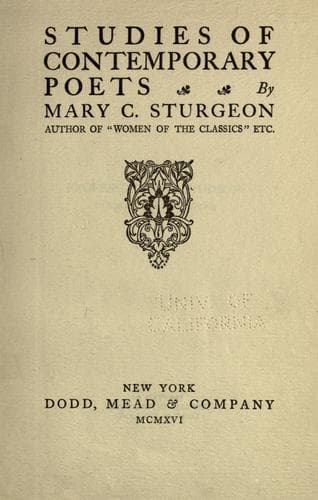
English poetry -- 20th century -- History and criticism
Looking at the work thus, and noting its mass and general character, one
is impelled to pay a first tribute to the fertility of the genius from
which it springs, and to the strength and staying power of the dramatic
impulse which directs it. But we soon find that this is reinforced by
other qualities which are almost as remarkable. There is what one may
call a comprehensive intelligence, ranging over wide areas and gathering
material in many places, but keeping it all strictly under control and
constantly striving to relate and unify so much diversity. There is a
constructive gift patiently building up, fitting together, organizing
and articulating the form of the work. Selection acts persistently;
proportion is generally--though not always--true and fine; a noble
spirit and a manner at once gracious and dignified give the work
distinction.
However, all that is little more than to say--here is a genuine artist
working conscientiously in a given medium. It does not go far towards a
relative estimate of the work as pure drama. Only a detailed critical
analysis could do that adequately; though one may perhaps try to
indicate two or three of the prominent features of the plays. Thus in
_Joan of Arc_ we meet at once certain qualities which become in the
later plays definitely characteristic. There is, for example, a
conception of the theme which stresses the element of spiritual
conflict, and draws upon it, as well as upon its human values, for
dramatic inspiration. That is a primary fact in all this work; and in
four of the five plays it is implied in the very name of the
protagonist. _Joan_, _Manin_, _Marcus Aurelius_ and _Belisarius_ are
synonyms for the purest spirituality of which human nature is capable.
They suggest, before a page of this poetry has been turned, that the
conflict out of which drama always springs is in this case largely a
matter of invisible forces--of principles and ideas. And they point to
a type of dramatic art which, trending to fine issues, inevitably deals
in quiet effects.
There is, in fact, in the extreme grandeur of these four characters, a
possible source of weakness to the plays, as actual drama. There is a
danger that Joan may be too good a Christian, Marcus Aurelius too
austere a stoic, Manin or Belisarius too absolute an idealist, to put up
a strenuous fight against destiny. In the final impression of the plays,
indeed, one is aware of a vague touch of regret on that very account;
and although that may arise from one's own pugnacity, one suspects the
existence of a good many other imperfect humans who will share it; from
which it may be inferred that the weakness inherent in the subject has
not been entirely overcome. I doubt whether it would be possible to
overcome it altogether; and by the same token I salute the power which
has evoked profoundly moving and stimulating drama out of themes like
these.
Public-domain text, read in full here on John Shaqi.
Reviews
Reviews
No reviews yet
Be the first to share your thoughts on this work.
Elsewhere in the archive
Join the Discussion
Join the discussion
Sign in to leave a comment or review.
Sign InorCreate an account