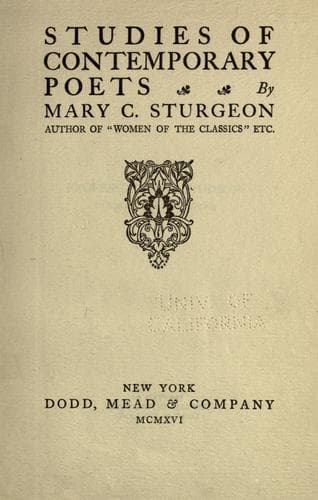
English poetry -- 20th century -- History and criticism
By means of a flexible blank-verse, plain diction, and free and nervous
phrasing, dialogue runs with an easy vigour. It is fired by strong and
quickly changing emotion--the incredulity of Charles, the base hostility
of la Tremoille, the indignation of Joan's friends, or the amazement and
curiosity of the courtiers. But for the most part it remains strictly
dramatic poetry; that is to say, raised by several degrees above the
level of prose, yet closely fitted to personality. When, however, Joan
begins to tell about her life, her quiet country home, and the divine
command which bade her save her country, the note deepens. The verse
becomes lyrical, burning with the mystical passion which possesses
her--a flame, like the grand simplicity of her own nature, white and
intensely clear.
JOAN. Sire, it was in the spring; one afternoon
When I was in a meadow all alone,
Lying among the grasses (over head
The scurrying clouds were like a flock of sheep,
Chased by a sheep-dog); then, all suddenly,
I heard a voice--nay, heard I cannot say,
There _was_ a voice took hold upon my sense,
As if it swallowed up all other sounds
In all the world; the birds, the sheep, the bees,
The sound of children calling far away,
The rustling of the rushes in the stream,
Were only like the cloth, whereon appears
The gold embroidery, the voice of God.
ARCHBISHOP. Did you see aught?
JOAN. Yea, see! Our earthly words
Cannot express divinity, but like
Small vessels over-filled with generous wine,
They leave the surplus wasted. If I say,
I saw, or heard, that seems to leave untouched
The other senses; but indeed, my lords,
All of my body seemed transformed to soul.
So I should say I _saw_ the voice of God,
And _heard_ the light effulgent all around,
Nay, heard, and saw, and felt through all of me
The radiance of the message of the Lord.
Passages like that bring home to us the poetical character of this
drama. True, they may remind us that in such a form of the art action
is likely to lag: that its movement may be impeded, as toward the end of
_Joan of Arc_, by long speeches. On the other hand, they emphasize the
peculiar virtue of this kind of drama; the twofold nature of its appeal,
and the fact that the two elements are often found concentrated at their
highest degree in single scenes of great power. With genius of this type
(if genius may be classified in types!), when the dramatic imagination
is most vividly alight, it will inevitably kindle poetry of the finest
kind.
Public-domain text, read in full here on John Shaqi.
Reviews
Reviews
No reviews yet
Be the first to share your thoughts on this work.
Elsewhere in the archive
Join the Discussion
Join the discussion
Sign in to leave a comment or review.
Sign InorCreate an account