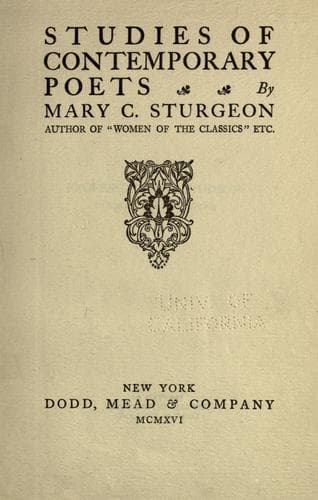
English poetry -- 20th century -- History and criticism
Thus, in the last act of _Marcus Aurelius_, we get the force of the
whole drama, and all the incidence of the directly preceding scene
moving behind and through the Emperor's speech from which I shall quote.
The play has shown the complicity of Faustina in the plot to depose her
husband: we know that she is a wanton and a traitress. But Marcus is
ignorant of the truth, and generously unsuspecting. After the death of
Cassius, the chief conspirator, Marcus orders an officer to bring all
the dead man's papers to him. It is necessary to examine them for the
names of accomplices. They are brought in while he is chatting with
Faustina; and she knows that they contain certain incriminating letters
that she had written. Exposure is imminent--disgrace and probable death
for her await the opening of the letters. She tries every ruse that a
bold and cunning mentality can suggest to prevent her husband from
reading them. She seems about to succeed, but her insistence faintly
warning Marcus, she fails after all. He takes up the package and goes
away to open it quietly in his tent, and Faustina, believing that in a
few minutes he will know all her treachery, drinks poison and dies.
Unconscious of this catastrophe, the Emperor is sitting alone in his
tent, with the package of letters on a table before him.
... Here, beneath my hand,
Are laid the hidden hearts of many men.
What shall I read therein? Ingratitude,
Lies, envy, spite, the barbed and venomous word
Of those that called me Emperor, I called friend;
... Break the seal, and read
Which of our subjects, of our intimates,
Our friends of many years, are netted here.
How thickly fall the shadows in the tent!
Almost I fancied, with my tired eyes,
I saw Faustina there ... Faustina, you!
.....
If I should find
_Her_ name among the friends of Cassius?
Ah no, Faustina, not such perfidy!
The gods must blush at it! Am I grown grey
And learnt no wisdom? Though it should be so--
Though yet it cannot be--what's that to me?
Am _I_ wronged by it? Yet it cannot be,
With that frank brow. I've loved you faithfully;
It could not be so....
... I will not know
More than I must of unprofitable things,
Lest they should, in the garden of my soul,
Nourish rank weeds of hate and bitterness;
I will not hate that which I cannot change.
(_He drops the papers into a tripod._)
Burn! Go into oblivion! The gods
Permit themselves to pity good and bad,
Giving to each the sunshine and sweet rain,
And hiding all things in the mist of years.
May I not do as gods do? Burn away,
Consume all hate and evil into smoke!
I will not know of them; assuredly
For me such ills exist not----
(_The body of Faustina is brought in._)
Public-domain text, read in full here on John Shaqi.
Reviews
Reviews
No reviews yet
Be the first to share your thoughts on this work.
Elsewhere in the archive
Join the Discussion
Join the discussion
Sign in to leave a comment or review.
Sign InorCreate an account