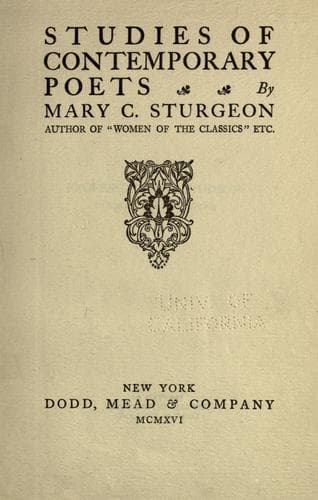
English poetry -- 20th century -- History and criticism
The gentleness of that gives place at the entrance of Darnley to intense
scorn, changing to indignation when he compels her to answer him, and to
provocative coquetry at his insult to Rizzio. In the second scene of
this act a new aspect of her mentality develops. The action here,
dramatically splendid in its speed and emotion, grows out of Mary's
recklessness, and proceeds directly, through the jealousy of Darnley,
to Rizzio's murder and Mary's secret plot to avenge him. It would seem,
in the astonishing duplexity of her nature, that there could be nothing
more to reveal; yet the profounder forces of it only begin to be
operative from this point. Bothwell, as she designs the scheme, is to be
merely the tool of her shrewd intelligence. But she is betrayed by the
force of her own passion, which transforms Bothwell into the means of
her destruction. The finest achievement of this portrayal is that which
shows the Queen conscious of her infatuation, and perceiving the tragedy
which it is preparing, but incapable of stemming the flood that is
carrying her away. Intelligence remains acute: reason holds as clear a
light to consequence as ever it did, but both are ineffectual against
the storm of instinct. Here is a passage from the end of Act III in
which Bothwell after a rebuff has protested his love for the Queen:
MARY. Nay, swear not; nay, I know you what you are--
Hotter than flame in your desires; false--
Falser than water.
BOTHWELL (_embracing her_). Be a salamander,
To live for ever in the midst of fire.
MARY. Oh, Bothwell! Oh, my love! I am bewitched
To love you so. You are a deadly poison
That's crept through all my veins; you are the North,
And I the needle; I must turn to you
From every quarter of the hemispheres.
... I am yours
Utterly, wholly; when I walk abroad,
Jewelled and brocaded, I feel all men's eyes
Can see me naked, and, from head to foot,
Branded in red-hot letters with your name.
BOTHWELL. This is indeed love!
MARY. You may call it so!
It is not that which most men mean by love--
A moment's idle fancy. No, this love
Is like a dragon, laying waste the land
Of all my life; it is a deadly sickness,
Of which we both shall die; it is a sin,
Of which we both are damned, the saints of God
Not finding mercy; there's no pleasure in it,
But dust in the mouth and saltness in the eyes.
Public-domain text, read in full here on John Shaqi.
Reviews
Reviews
No reviews yet
Be the first to share your thoughts on this work.
Elsewhere in the archive
Join the Discussion
Join the discussion
Sign in to leave a comment or review.
Sign InorCreate an account