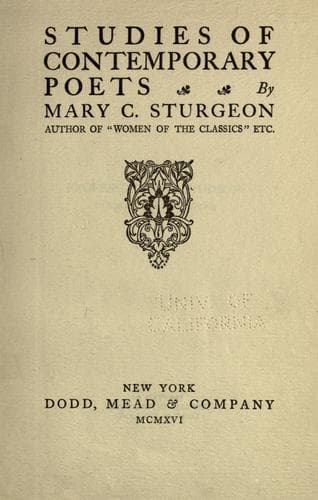
English poetry -- 20th century -- History and criticism
One would like to indicate further the truth with which the character is
studied through the last two acts, providing the material as it does for
scenes of great power and range of effect. Particularly one would wish
to convey some idea of the scene of the final tragedy, broadly conceived
against a background of the angry Edinburgh populace, and throbbing with
the defiance of the Queen. Psychological imagination here is no less
than brilliant, and one could cull perhaps half a dozen passages to
illustrate it. But a single extract must suffice; and that is chosen for
the additional reason that its closing sentences contain the very root
of the tragedy. It is from Act IV, and the scene, following upon Mary's
marriage to Bothwell, is designed to show her last desperate struggle
against him and against herself. Already she is remorseful,
disillusioned, and bitter; she knows the marriage to be hateful to her
people, and she has found Bothwell cruel and treacherous. Before the
nobles, who are assembled to receive them, she taunts Bothwell that he
is not royal; flouts him for Arthur Erskine; declares that she will
never wear jewels again; and at last provokes from Bothwell angry abuse
and threats of violence. The nobles interpose to protect her, and beg
her to let them save her from him. It needs but one word of assent to be
rid of him for ever. She is almost won; she takes a few steps towards
them, and actually gives her hand to one of them. Then she hesitates,
turns, and looks at her husband:--
MARY. I am yours, Bothwell.
BOTHWELL. Will you go with me?
MARY. Ay, to the world's end, in my petticoat.
BOTHWELL. Let go her hands, my lord.
MORTON. Ay, let them go,
And let _her_ go, for naught can save her now.
Not ours the fault.
MARY. Not yours, nor his, nor mine.
'Tis not the fault of floods to drown, nor fire
To burn and shrivel--no, nor beasts to bite,
Nor frosts to kill the flowers--not the fault,
Only the property. There's something here
That's stronger than our wishes and our wills.
There is no going back; our course is laid,
And we must keep it, though it lead to death.
Good-bye, my lords. My husband, let us go.
_James Stephens_
One does not put a poet like Mr Stephens into a group--it cannot be
done. If you try to do it, weakly yielding a wise instinct to mere
intelligence, one of two things will happen. You will return to your
careful group the moment after you thought you had made it, to find
either that Mr Stephens has vanished or that the others have. Either he
has broken away from the ridiculous frail links which bound him, and is
already disappearing on the horizon with a gleeful shout, or his
unfortunate companions have vanished before so much exuberance.
Public-domain text, read in full here on John Shaqi.
Reviews
Reviews
No reviews yet
Be the first to share your thoughts on this work.
Elsewhere in the archive
Join the Discussion
Join the discussion
Sign in to leave a comment or review.
Sign InorCreate an account