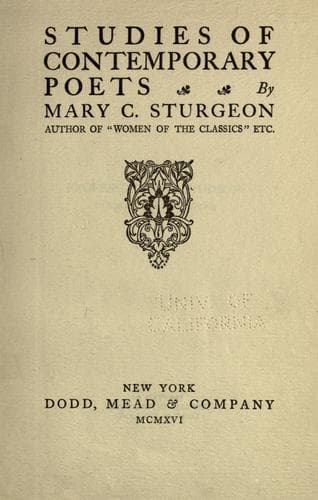
English poetry -- 20th century -- History and criticism
These outward marks are unmistakable; and so, too, are certain qualities
in the essence and texture of the work. His lyric moods may be as tender
and fanciful, though always more spontaneous, than those of Mr Yeats.
And one may find the arrowy truth, the rich earthiness and the profound
sense of tragedy of a Synge. But the filmy threads which seem to stretch
between Mr Stephens and his compatriots have no strength to bind him.
They are, indeed, only visible when he is ranging at some altitude that
is lower than his highest reach. When he soars to the zenith, as in
"The Lonely God" and "A Prelude and a Song," their tenuity snaps. He has
gone beyond what is merely national and simply human; and has become
just a Voice for the Spirit of Poetry.
Nevertheless the affinities of this poet with what is best in modern
Irish literature would make a fascinating study. Foremost, of course,
there is imagination. You will find in him the true Hibernian blend of
grotesquerie and grandeur, pure fantasy and shining vision. But each of
these things is here raised to a power which makes it notable in itself,
while all of them may sometimes be found in astonishing combination in a
single poem. In the book called _Insurrections_, which is dated 1909,
and appears to represent Mr Stephens' earliest efforts in verse, there
is the piece which I have already named, "What Tomas an Buile Said in a
Pub." Already we may see this complex quality at work. Tomas is
protesting that he saw God; and that God was angry with the world.
His beard swung on a wind far out of sight
Behind the world's curve, and there was light
Most fearful from His forehead ...
.....
He lifted up His hand--
I say He heaved a dreadful hand
Over the spinning Earth, then I said "Stay,
You must not strike it, God; I'm in the way;
And I will never move from where I stand."
He said "Dear child, I feared that you were dead,"
And stayed His hand.
You will see--a significant fact--that there is no nonsense about a
dream or a transcendent waking apparition. In the opening lines Tomas
says, with anxious emphasis, that he saw the 'Almighty Man'--and that is
symbolical. It has its relation to the mellow tenderness with which the
poem closes; but apart from that it is a sign of the way in which the
creative energy always works in this poetry. It seizes upon concrete
stuff; and that is fused, hammered and moulded into shapes so sharp and
clear that we feel we could actually touch them as they spring up in our
mental vision. This is not peculiar to Mr Stephens, of course. It would
seem to be common to every poet--though to be sure they are not many--in
whom sheer imagination, the first and last poetic gift, is preeminent.
Mr Stephens has many other qualities, which give his work depth, variety
and significance; but fine as they are, they take a secondary place
beside this ardent, plastic power.
Public-domain text, read in full here on John Shaqi.
Reviews
Reviews
No reviews yet
Be the first to share your thoughts on this work.
Elsewhere in the archive
Join the Discussion
Join the discussion
Sign in to leave a comment or review.
Sign InorCreate an account