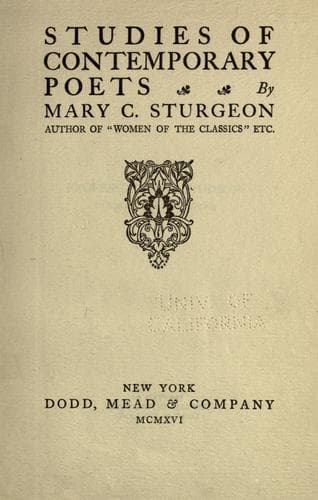
English poetry -- 20th century -- History and criticism
There follows hard upon that what is in effect a confession of faith. It
is not explicitly so, of course. Subjective this poet may be--is it not
a virtue in the lyricist?--but he does not confide his religion to us in
so many words. He has an artistic conscience. But the avowal, though it
is by way of allegory and grows up out of the imagery of the poem as
naturally as a blossom from its stem, is clear enough. And is supported
elsewhere, implicitly, or by a mental attitude, or outlined now and then
in figurative brilliance. There can be no reason to doubt its strength
and its sincerity--and there is every reason to rejoice in it--for it
reveals Mr Stephens as a poet of the future.
One pauses there, realizing that the term may mean very much--or nothing
at all. It may even suggest a certain technical vogue which, however
admirable in the theory of its originators, apparently is not yet
justified in the creation of manifest beauty. Our poet has no
association with that, of course, except in that he shares the general
impulse of the poetic spirit of his generation. That is, quite clearly,
to escape from the tyranny of the past in thought and word and metrical
form; and therein he is at one with most of the poets in this book. We
may grant that it is an important exception: that the movement which is
indicated here may be the sober British version of its more daring
Italian counterpart. Yet there remains still a difference wide enough
and deep enough to disclaim any technical relationship.
The root of the matter lies there, however. In Mr Stephens what we may
call the poetic instinct of the age works not merely to escape from the
past, but to advance into the future--and it has become a conscious,
reasoned hope in human destiny. It does not with him so much influence
the form of the work as it directs the spirit of it. And that spirit is
an absolute and impassioned belief in the future of mankind. Therein he
stands contrasted with many of the younger English poets, and with his
own compatriots. With many of his compeers the escape has been into
their own time, and the noblest thing evolved from that is a grave and
tender social conscience. Some, of course, have not escaped at all, and
have no wish to do so. Their work has its own soft evening loveliness.
But whilst Mr Yeats lives delicately in a romantic past, whilst poor
Synge lived tragically in a sardonic present, this poet stands on his
hill of vision and cries to the world the good tidings of a promised
land. Here it is, from the closing passage of "A Prelude and a Song":
Public-domain text, read in full here on John Shaqi.
Reviews
Reviews
No reviews yet
Be the first to share your thoughts on this work.
Elsewhere in the archive
Join the Discussion
Join the discussion
Sign in to leave a comment or review.
Sign InorCreate an account