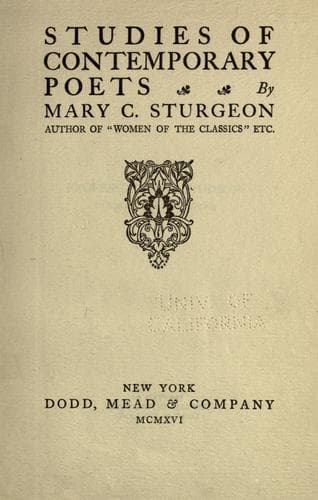
English poetry -- 20th century -- History and criticism
There the flower springs,
Therein does grow
The bud of hope, the miracle to come
For whose dear advent we are striving dumb
And joyless: Garden of Delight
That God has sowed!
In thee the flower of flowers,
The apple of our tree,
The banner of our towers,
The recompense for every misery,
The angel-man, the purity, the light
Whom we are working to has his abode;
Until our back and forth, our life and death
And life again, our going and return
Prepare the way: until our latest breath,
Deep-drawn and agonized, for him shall burn
A path: for him prepare
Laughter and love and singing everywhere;
A morning and a sunrise and a day!
_Margaret L. Woods_
About one half of the poetry in Mrs Woods' collected edition is dramatic
in character. There are two plays in regular form, tragedies both. One,
_Wild Justice,_ is in six scenes which carry the action rapidly forward
almost without a break. The other, called _The Princess of Hanover_, is
in three acts, which move with a wider sweep through the rise,
culmination, and crisis of a tragic story. These two dramas, which are
powerfully imagined and skilfully wrought, are placed in a separate
section at the end of the book--quite the best wine thus being left to
finish the feast.
Fine as they are, however, the plays do not completely represent the
poet's dramatic gift. And when we note the comic elements of two or
three pieces which are tucked away in the middle of the volume, we may
admit a hope that Mrs Wood may be impelled on some fair day to attempt
regular comedy. There is, for instance, the fun of the delightful medley
called "Marlborough Fair." Here are broad humour and vigorous, hearty
life which smells of the soil; little studies of country-folk,
incomplete but vivid; scraps of racy dialogue, and the prattle of a
child, all interwoven with the grotesquer fancies of a fertile
imagination, endowing even the beasts and inanimate objects of the show
with consciousness and speech. Hints there are in plenty (though to be
sure they are in some cases no more than hints) that the poet's dramatic
sense would handle the common stuff of life as surely and as freely as
it deals with tragedy. In this particular poem, of course, the touches
are of the nature of low comedy; the awkward sweethearting of a pair of
rustic lovers; the showman, alternating between bluster and enticement;
the rough banter of a group of farm lads about the cokernut-shy, and the
matron who presides there--
Swarthy and handsome and broad of face
'Twixt the banded brown of her glossy hair.
In her ears are shining silver rings,
Her head and massive throat are bare,
She needs good length in her apron strings
And has a jolly voice and loud
To cry her wares and draw the crowd.
Public-domain text, read in full here on John Shaqi.
Reviews
Reviews
No reviews yet
Be the first to share your thoughts on this work.
Elsewhere in the archive
Join the Discussion
Join the discussion
Sign in to leave a comment or review.
Sign InorCreate an account