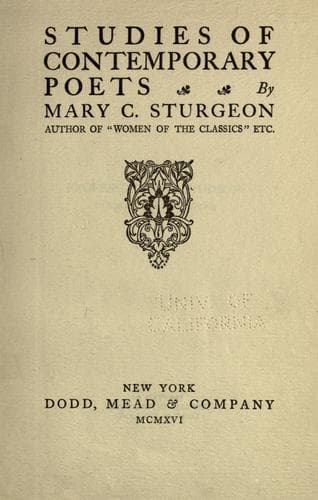
English poetry -- 20th century -- History and criticism
In a summary of this kind it is impossible to indicate all the dramatic
values of the work. One cannot show, for instance, how the characters
come to life, and by touches bold or subtle, develop an individuality
out of which the conflict of the drama springs. Even the conflict itself
can hardly be suggested, for an outline of the story gives only the
physical action; whilst there is a spiritual struggle in the minds of at
least two of the characters which is infinitely more tragical. And
neither can one hope to convey any sense of the force with which the
play takes possession of the mind. That is of course, its chief artistic
excellence; and on a moment's consideration it is seen to be a
remarkable achievement. For although the poet is working towards a
catastrophe very remote from ordinary experience, and in a poetic medium
deeply stamped with the marks of an earlier age, she has succeeded in
evoking a powerful illusion of reality. Here and there, indeed, are
signs that the handicap she has imposed upon herself is almost too
great. There is, perhaps, a shade of excess in the portraiture of
Gwyllim; or, to put it in another way, the author has not taken an
opportunity to balance what is extraordinary in this character with the
relief which would have suggested a complete personality. And now and
then there is a hint of incongruity in the use of a rich Elizabethan
diction, even for Owain, who is supposed to be steeped in the literature
of that age.
Those are not radical defects, however, for they do not interrupt the
enjoyment of the drama: they only emerge as an afterthought. If the
incompleteness of Gwyllim disturbed our conviction of his villainy, the
whole plot would be weakened. Whereas we are profoundly convinced that
the wrongs of his family are intolerable, and the revolt a natural
consequence. Similarly, if the exuberant Elizabethan language were
really unfitted to the spirit of the work, I imagine that it would be
barely possible to read the drama through, so irritating would be its
ineptitude. But, as a fact, the language wins upon us somehow as the
right expression for these people. We are probably satisfied,
subconsciously, that human creatures who have been thrust back to an
almost elemental stage of passion and thought, might talk in some such
way. In any case the emotional force of that old style, with its vivid
imagery and metaphor and its copious flow, does somehow suit the
intensity and gloomy grandeur of this play.
Public-domain text, read in full here on John Shaqi.
Reviews
Reviews
No reviews yet
Be the first to share your thoughts on this work.
Elsewhere in the archive
Join the Discussion
Join the discussion
Sign in to leave a comment or review.
Sign InorCreate an account