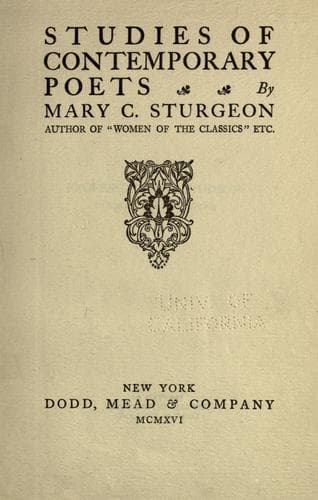
English poetry -- 20th century -- History and criticism
I am not sure that it suits _The Princess of Hanover_ quite so
well--which is curious, considering that we have, in the royal theme of
this drama, a subject which might be supposed to require an ornate
style. But in treating the tragic love-story of Sophia of Zell the poet
was bound to reproduce something of the atmosphere of the Hanoverian
Court, with its intrigues and indecencies and absurd conventionality.
And at such points poetry lends too large a dignity. In those scenes,
however, where as in "Wild Justice," the author comes to deal with naked
passion and with turbulent thought that is driving some person of the
drama to disaster, the instrument is admirably fitted to its purpose.
Thus, in the second half of the play, when the unfortunate Princess at
last yields to her lover, Königsmarck, and plots with him to escape from
her sottish husband, there are moments when it seems that no other
medium would serve. There is, for example, the crucial scene in the
second act when the endurance of the Princess finally gives way. The
action turns here directly towards its tragic culmination; for the
Princess, who had hitherto saved her honour at the cost of her love,
suddenly breaks down at an insult from the old Electress. The revulsion
of feeling as she flings restraint away carries her to an ecstatic sense
of liberty. As the Electress goes out and she is left alone with her
lady-in-waiting, she laughs bitterly and declares that she is now free
for ever from the House of Hanover.
LEONORA. Weeping, dear lady,
Will balm our misery better than laughter.
PRINCESS. Misery? I am mad with all the joy
Of all my years, my youth-consuming years'
Hoarded, unspent delight.
Say, Leonora,
Where are my wings? Do they not shoot up radiant,
A splendour of snowy vans, swimming the air
Just ere the rush of rapture?
One might quote a dozen such passages, in which a rush of emotion seems
to overflow most naturally into poetical extravagance. There is the
rhapsody of the Electress--significantly, upon the theme of Queen
Elizabeth. There are the love-scenes, passionate or tender, between
Königsmarck and the Princess; and the fierce moods--of sheer avidity or
hatred or remorse--of the courtesan who contrives their downfall. But
the only other illustration which need be given is taken from the last
scene of the play; and has a further importance which must be noted. I
mean the tragic irony which underlies it, and, running throughout the
scene, closes the play on a note of appalling mockery.
Public-domain text, read in full here on John Shaqi.
Reviews
Reviews
No reviews yet
Be the first to share your thoughts on this work.
Elsewhere in the archive
Join the Discussion
Join the discussion
Sign in to leave a comment or review.
Sign InorCreate an account