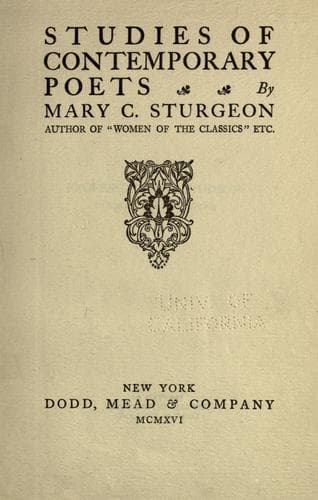
English poetry -- 20th century -- History and criticism
In the sweet chorus of modern poetry one may hear a strange new harmony.
It is the life of our time, evoking its own music: constraining the
poetic spirit to utter its own message. The peculiar beauty of
contemporary poetry, with all its fresh and varied charm, grows from
that; and in that, too, its vitality is assured. Its art has the deep
sanction of loyalty: its loyalty draws inspiration from the living
source.
There is a fair company of these new singers; and it would seem that
there should be large hope for a generation, whether in its life or
letters, which can find such expression. Listening carefully, however,
some notes ring clearer, stronger, or more significant than others; and
of these the voice of Mr Abercrombie appears to carry the fullest
utterance. It is therefore a happy chance that the name which stands
first here, under a quite arbitrary arrangement, has also a natural
right to be put at the head of such a group of moderns.
But that is not an implicit denial to those others of fidelity to their
time. It is a question of degree and of range. Every poet in this band
will be found to represent some aspect of our complex life--its awakened
social conscience or its frank joy in the world of sense: its mysticism
or its repudiation of dogma, in art as in religion: its mistrust of
materialism or keen perception of reality: its worship of the future, or
assimilation of the heritage of the past to its own ideals: its lyrical
delight in life or dramatic re-creation of it: its insistence upon the
essential poetry of common things, or its discovery of rare new values
in experience and expression.
This poetry frequently catches one or another of those elements, and
crystallizes it out of a mere welter into definite form and recognizable
beauty. But the claim for Mr Abercrombie is that he has drawn upon them
more largely: that he has made a wider synthesis: that his work has a
unity more comprehensive and complete. It is in virtue of this that he
may be said to represent his age so fully; but that is neither to accuse
him of shouting with the crowd, nor to lay on the man in the street the
burden of the poet's idealism. He is, indeed, in a deeper sense than
politics could make him, a democrat: perhaps that inheres in the poetic
temperament. But intellectuality like his, vision so brilliant, a spirit
so keen and a sensuous equipment so delicate and bountiful are not to be
leashed to the common pace. That is a truism, of course: so often it
seems to be the destiny of the poet to be at once with the people and
above them. But it needs repetition here, because it applies with
unusual force. This is a poet whose instinct binds him inescapably to
his kind, while all the time his genius is soaring where the average
mind may sometimes find it hard to follow.
Public-domain text, read in full here on John Shaqi.
Reviews
Reviews
No reviews yet
Be the first to share your thoughts on this work.
Join the Discussion
Join the discussion
Sign in to leave a comment or review.
Sign InorCreate an account