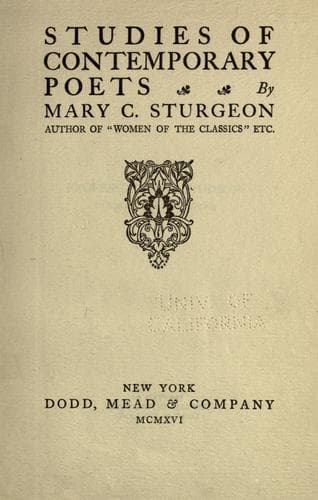
English poetry -- 20th century -- History and criticism
Being wise after the event, one can discover auguries of that change in
the very early work. There is, for example, a group of little poems
called _Faring South_, studied directly from peasant life in the south
of France. They indicate that even at that time an awakening sympathy
with toiling folk had begun to guide his observation; and they are in
any case a very different record of European travel from that of the
mere poetaster. There are studies of a stonebreaker, a thresher, a
ploughman; there is a veracious little picture of a housemother,
returning home at the end of market-day laden, tired and dusty; but
happy to be under her own vine-porch once more. And most interesting of
all the group, there is a shepherd, the forerunner of robuster shepherds
in later books, and evidently a figure which has for this author a
special attraction.
With folded arms, against his staff he stands,
Sun-soaking, rapt, within the August blaze
The while his sheep with moving rustle graze
The lean, parched undergrowth of stubble lands.
Indifferent 'neath the low blue-laden sky
He gazes fearless in the eyes of noon;
And earth, because he craves of her no boon,
Yields him deep-breasted, sun-steeped destiny.
But these characters are not living people, they are types rather than
individuals, and idealized a little. They are, as it were, seen from a
distance, in passing, and in a golden light. Years were to pass before
knowledge and insight could envisage them completely and a dramatic
sense could endow them with life. Meantime the more characteristic
qualities of this early work were to develop independently. The lyrical
power of it, in particular, was to enjoy its flowering time, revelling
in the sweet melancholy of old unhappy love stories, in courts and
rose-gardens, kings and queens, knights and ladies and lute-players.
Perhaps the most charming examples in this kind are "The Songs of Queen
Averlaine." Here are a couple of stanzas from one of them, in which the
queen is brooding sadly over the thought of her lost love and lost
youth:
Spring comes no more for me: though young March blow
To flame the larches, and from tree to tree
The green fire leap, till all the woodland, glow--
Though every runnel, filled to overflow,
Bear sea-ward, loud and brown with melted snow,
Spring comes no more for me!
.....
Spring comes no more for me: though May will shake
White flame of hawthorn over all the lea,
Till every thick-set hedge and tangled brake
Puts on fresh flower of beauty for her sake;
Though all the world from winter-sleep awake,
Spring comes no more for me!
Public-domain text, read in full here on John Shaqi.
Reviews
Reviews
No reviews yet
Be the first to share your thoughts on this work.
Join the Discussion
Join the discussion
Sign in to leave a comment or review.
Sign InorCreate an account